
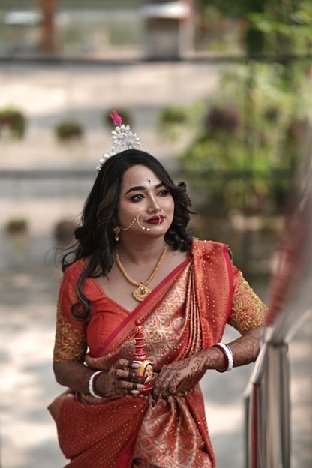
- You are an accomplished scholar in literature. How does being a woman affect how you view and relate to that world?
Purbasha Mondal: Women are more sensitive than men. But in a patriarchal society, Dalit women are the worst sufferers. As a Dalit scholar, I have suffered a lot. Even we have been ignored and excluded from history. Our contributions were never acknowledged. We do not want savarna feminism in India. This kind of feminism cannot save us. The so-called feminists cannot solve our problems. Now we are powerful. We are well-versed. We can worship our God without a Brahmin priest. As a Matua woman, I feel that I am empowered now. Dr. B. R. Ambedkar, the architect of Indian Constitution tried to erase gender discrimination from our society. Still I believe, many women, mostly the tribal women, are the victims of patriarchal society. When I did my fieldwork on Santali women in Bankura I came to know about their struggle, lifestyle and daily routines. You will be amazed if you see their drawings (alpana) on the muddy walls and also on the floors of houses. Santali women are the great artists. They are famous for their Santali dance. But I was surprised to know that Santali women do not have the right to worship their God directly because they are women. Currently, I teach at Saltora Netaji Centenary College (Affiliated to Bankura University) where most of our students are from tribal communities. Most of them are female students belonging to SC (Scheduled Caste) or ST (Scheduled Tribe). I am a programme officer of NSS Unit-II in our college. I am Master Trainer of Bankura University. When I visited our adopted village, Bamnishala (the adopted village of NSS Unit-II) I noticed that most of the women were malnourished suffering from poverty. I am also the Convenor of Women’s Cell in our college. On behalf of Women’s Cell, we launched Ritusathi: Menstrual Hygiene Initiative for the underprivileged women of Bamnishala, Nutandihi and College Para. We distribute free sanitary napkins to the women of our adopted villages. On behalf of NSS Unit-II, we also donate fruits and foods to the women of Bamnishala so that they can fulfil their nutritional needs especially during menstruation and pregnancy. These women often face health issues. I told them to visit health centres and consult their health issues with Asha Didis. As a woman, I can feel their pain in a caste-ridden society. We have organized various awareness sessions on ‘Save the Girl Child’ to raise awareness among our female students and the women of our adopted villages. The wall magazines of NSS Unit-II and Women’s Cell were well decorated by our female students including NSS female volunteers. We have creative skill. We need to nurture our souls. We can solve our problem. We do not need savarna feminism for that. Our power lies in our inner self. Yes, we can speak for ourselves.
- In this century after so much effort into reform and advocacy for equality for women, does being a woman hinder you institutionally in any way? Does the "male gaze" still affect you as a scholar?
Purbasha Mondal: In Matua religion, men and women are equal. I am a follower of Matua Dharma formed by Harichand Thakur. I am lucky to have supporting parents who motivated me to complete my study. My mother, Dr. Puspa Bairagya has always been my guide. Now, I have understood the importance of education. I have done B. A. in English from Rabindra Bharati University. I was the topper (First Class First) of my batch. Still I have faced obstacles there. When I started doing M. A. I was not allowed to sit in the final examination. I had panic attack. I was cured by my parents. Then I completed my M. A. in English from University of Calcutta. I received immense love from my Professors at University of Calcutta.
Yes, the “male gaze” negatively affects my psychology.
- How would other women you interact with internationally view your statements on this, from your perspective? Do you think they feel similarly or have diverging views?
Purbasha Mondal: Women are facing these problems everywhere. The Indigenous women suffer the most. Every woman is a story teller. We are born as women. We fight against gender discrimination. Most of the time our stories embrace each other.


 English
 Afrikaans
 Arabic
 Bengali
 Bulgarian
 Chinese (Simplified)
 Dutch
Dutch Filipino
 Finnish
 French
 German
 Greek
Greek Hausa
Hausa Hindi
Hindi Hungarian
 Igbo
Igbo Italian
 Japanese
 Korean
 Malay
Malay Malayalam
 Polish
 Portuguese
 Punjabi
 Romanian
 Russian
 Serbian
 Slovak
 Spanish
 Swahili
 Ukrainian
 Urdu
Urdu Yoruba