
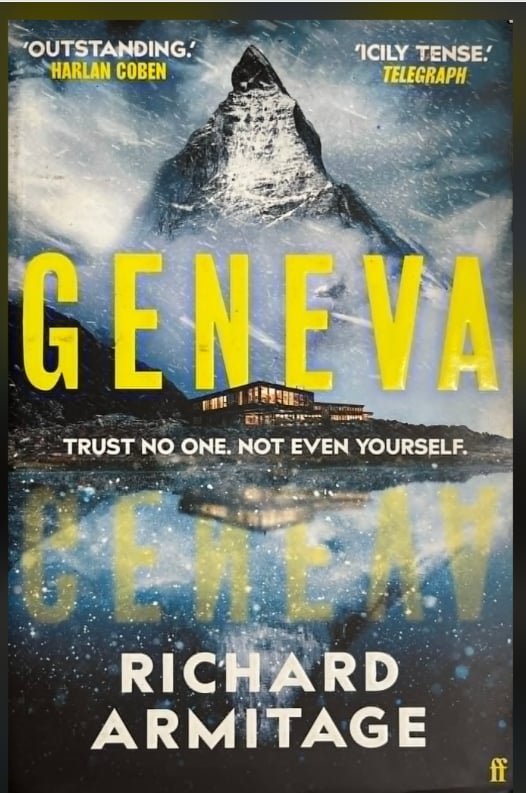
-A commentary on ‘Geneva’ penned by the accolade-winning, highly acclaimed Richard Armitage, published by Faber and Faber, UK.
While I admit I am not quite familiar with most of Mr. Richard Armitage’s thespian and cinematic roles, I was more than impressed with his masterful rendition of the majestic Dwarven Warrior-King Thorin Oakenshield from ‘The Hobbit’ trilogy. From interviews and general evaluations (and from my own perspective), I have noted his brilliant performance through just his eyes, gait, regal demeanour and depth in voice. So, what happens when a method-actor of his ilk with his well-known fondness for literature turns into an author of thrills and surprising plot-twists?
I shall begin my dissertation with an axiom of mine, tried and tested. In my career as a writer and a poet, I have served as an editor as well. It is my long-time belief- if the opening paragraph fails to captivate, nothing else can. Mr. Armitage begins his novel with-
‘A shard of ancient granite thrusts upwards through the white origami folds of the Swiss Alps, piercing the low-hanging cloud.’
Simple, crisp, concise and with the correct amount of brevity, no lyrical prose of grandiosity, no flowery language. Even if the book had no image of Matterhorn on the cover, any reader would be able to picture the image of that particular peak with swirling fog.
Moving on to the structure of the book, it contains alternating points of view of the two protagonists, Nobel laureate Sarah Collier and her husband Daniel Collier, sometimes interspersed with highly excitable comments from a vivacious, exuberant blogger Terri Landau, often loose-lipped, with little to no regard for privacy, prepared to expose the underhanded dealings of pharmaceutical companies.
Mr. Armitage’s approach to his text in present tense adds a certain amount of charm and wit, for one is inclined to experience the primal rawness and the visceral instincts of Sarah alongside her. I do not know about others, but, in my case, the first chapter struck a chord with me and hit too close to home, more than I would have liked. However, I do not mean it in a derogatory way; it serves as a glowing testament to Mr. Armitage’s prowess at his craft. I refer to two salient points- namely a Magnetic Resonance Imaging test and the infamous Alzheimer’s Disease. The writer’s extensive descriptions of the first stages of the mental ailment have cripplingly resonated with me on a ‘molecular’ level. The chapter narrates Sarah’s trials on the MRI table and the detailed reactions the magnetic device can induce in a person’s disease-addled brain. I have had several MRI tests done on me and once they shove the head into that hemispherical tunnel without light and a grating noise constantly thundering near the ears, the claustrophobic surroundings are exactly as the author writes in his novel. The fear of the dark, the horror of the unknown; every single aspect has been recounted with uncanny accuracy. I could practically sense that dreaded coldness closing in on me through his choice turn of phrases. Notwithstanding the double and triple jaw-dropping twists, Mr. Armitage’s chronicles of how a patient of the degenerative Alzheimer’s disease eventually sinks into a quagmire are just as upsettingly nostalgic. Again, I repeat it in a positive sense, which is evidence of the writer’s deep understanding of the human psyche and his expansive grasp on the English language. I have had, to put it in coarser terms, front row seats to the entire rise-and-fall of the Alzheimer’s deathly curse; that of my grandfather’s. It was painful to read about in ‘Geneva’, the specifics brought tears to my eyes. The agony of losing the self, that excruciating sensation of insecurity; each has been painted hauntingly beautifully. There is even an instance in the story where a character is said to have lost their way back home, unable to recall either name or location, found later in the streets. That was precisely what transpired in my grandfather’s case. One day, he was just… gone. Weeks later, a relative found him beside a bin of sorts; clothes, watch all missing, mumbling to himself. Writing this hurts me unbearably; at times I wished to simply set aside the novel and weep like a child. Once more, I mention it in a good way, a credit to the author’s skill with the pen.
Eventually, the reader chances upon the character traits of Sarah and Daniel. The former is, to quote from the book ‘fun mum… dedicated daughter, awesome wife’ with an underlying fear of dementia extending its feelers and trapping her into nothingness. Additionally, she is rather mortified at the thought that it was she alone who received the Nobel prize while her project involved heavy team-work; also, she is quite averse to appearing in public like a performing seal in an aquarium. The latter, her husband, is seemingly supportive and loving, deeply concerned about her failing health. Yet, certain sentences suggest a smattering of inferiority complex; male ego reduced at the cost of the little lady’s success-
‘The road of dwindling respect ends in a cul-de-sac of pity.’ An indicatory line. Perhaps the ‘love-light’ in his eyes was slowly fading?
‘“They want you, not me.” It’s uncomfortable to admit that.’ Envy, perchance?
‘There’s a painting that has always stuck in my mind. Nebuchadnezzar by William Blake. It depicts a great ruler who lost his sanity and was reduced to a kind of animal madness, crawling on his hands and knees, eyes bloodshot and haunted. It might be the…. stress of dealing with Sarah, but I see those same eyes staring right back at me now.’ This is one of the most disturbing bits in the book. This part of the New Testament is told in the Book of Daniel (coincidence? I think not), the dream-interpreter who foresaw the Babylonian monarch grovelling in the grass like cattle, cast away by Providence for his hubris. Maybe Mr. Armitage was laying down the groundwork for an event that would reveal Daniel’s personality in a light far removed from the worried husband. For, the sentence from the novel can be read in two ways- anxiety on behalf of his illustrious wife or affected by what he was to become later.
Mr. Armitage has created little ripples throughout his work so that they might amalgamate into a larger wave to crash against an eager reader’s excited heart. I am of the opinion that he planted seeds as he progressed, hoping they would bear fruit, neatly dovetailing all plot points. Such a writer can only be labelled a ‘natural’ who required no planning but simply watched the roots settle in deeper, carving a piece of himself in the reader’s mind.
We then come across elderly disabled Mauritz Schiller, the sovereign of the Schiller Institute at the edge of the lake at the foothills of Matterhorn, an ambitious fellow but not overly so, cradling a desire to merely leave behind a name. Following which, the reader learns of a no-nonsense woman, Helen Alder, who looks after the affairs of the sovereign, who is resourceful, eagle-eyed in precision and cunning, smartly clad with a ‘come-hither’ allure, nursing a rather demeaning opinion of others-
‘Dangle something shiny in front of Daniel Collier and he swoops like a magpie to grab it.’
Geneva, as people already know, is the hub of breakthroughs where like-minded researchers gather to fabricate devices even more ludicrous than the one that preceded it, to pull the rug under the feet of bemused laymen; the Large Hadron Collider immediately springing to mind. The novel capitalises on this and the backdrop of the tome thus becomes a conference to launch neuron implants in the head; and Sarah, with fame sprouting at her wake, is called upon to sanction it. Despite her black-outs and headaches, she wonders how ethical an implant without consent would be, realising full well it could act as a cure for her. At the same time, the bubbly blogger circles around like a vulture for her news channel, claiming she has someone on the inside. Amidst this chaotic setting, Sarah feels solitude, terror and exhaustion engulfing her, eyes darkening as emptiness encroaches. Daniel, on the other hand, feels like a fish out of water. And each time Helen Alder approaches, he flounders like a boy of sixteen, unsure of where to look.
As Mr. Armitage concludes his description of the conference, he writes a very interesting paragraph with regards to the lily-livered husband-
‘I glance up at the mirror. Spanning the glass is something I hadn’t noticed before. A large crack, running from one side to the other. It splits my face in two. My mouth is showing one face, my haunted eyes another.’
The line reminds me of The Lady of Shalott-
‘She look’d down to Camelot.
Out flew the web and floated wide;
The mirror crack’d from side to side;
“The curse is come upon me,”
cried The Lady of Shalott.’
Comparing the two, I can now tell myself, ‘How incredibly significant!’
When I first read ‘Geneva’, I finished it in one sitting. Upon a re-read three years later, I understand how Mr. Armitage had taken Willard Huntington Wright’s 20 rules for mystery fiction to heart-
‘The truth of the problem must at all times be apparent- provided the reader is shrewd enough to see it. If the reader, after learning the explanation of the crime, should re-read the book, they would see that the solution had been staring them in the face.’
For instance:- 1) The Nebuchadnezzar clue, 2) the blogger’s inside information, 3) the shattered mirror, 4) Mauritz Schiller ignoring Daniel even though the latter visited often, 5) a webcam inside Helen Alder’s office, 6) the husband’s uncharacteristic outburst about the Nobel laureate’s confession to the blogger that she is at the mercy of Alzheimer’s,7) a dilapidated cabin at the base of the hills with broadcasting equipment, 8) ‘We’re currently having a social awakening regarding assisted dying’, among others.
I simply was not clever enough. I bow before your razor-sharp acumen, Mr. Armitage. The very first credo of W.H. Wright’s (who was better known as SS Van Dine in literary circles) happens to be-
‘The reader must think along with the ‘detective’.’
I am afraid I have failed miserably on that account and I seek forgiveness. Every author desires to sort of hold a heart-to-heart parley through their work especially since Mr. Armitage has faithfully sprinkled all evidence generously across his gripping tale.
Furthermore, there is another matter I wish to touch upon- Mr. Armitage’s command over what is known as ‘Unreliable Narration’ that not many authors wish to tackle sans Jerome David Salinger; Holden Caulfield (‘The Catcher in the Rye’) being the misleading storyteller and Charles Dickens; where Pip (‘Great Expectations’) is the unreliable narrator. However, since ‘Geneva’ falls under the genre of ‘crime fiction’, I cannot help but compare his first-person speech to that of Dame Agatha Christie’s Dr. James Sheppard in ‘The Murder of Roger Ackroyd’.
The final few lines of the book’- ‘taking the road’ were so reminiscent of Professor J.R.R. Tolkien’s walking song:
‘The road goes ever on and on
Under cloud and under star
Yet feet that wandering have gone
Turn at last to home afar.
Eyes that fire and sword have seen
And horror in the halls of stone
Look at last on meadows green
And trees and hills they long have known..’
-that I find myself straying from my original question. What happens when a method-actor of Mr. Armitage’s calibre turns into an author of thrills and surprising plot-twists?
They see not a meadow but a vast sprawling moor that infinitely stretches. They see no stream but the ocean that can never sleep. They envision not today’s sky but the entire heaven’s itinerary. They learn pointillism, taking a step back to deeply embrace the bigger picture. As a result, they can make out the tiny fragments that shape the human sentience.
Yet another issue that must be factored in with regards to ‘Geneva’ is readability.
I am usually a reader of cozy countryside crime fiction that involves hardly any movement with flick knives, just an ample usage of the ‘little grey cells’. Hence, my patience tends to run thin when there is too much action going on. Then, imagine my surprise when I sailed through the conclusion of the book without a single sigh of boredom. Yes, Mr. Armitage completely took in stride the importance of lucid readability which, I am sure, shall serve as a powerful arsenal for his following novel.
It has been nearly 18 years since I last read a thriller with high stakes this amazing and I believe it would not be too far from the truth were I to call it at par with Dan Brown’s ‘Deception Point’.
I shall end my commentary by saying a person of such multi-faceted versatility comes along but once or twice in a decade and two years. So, dear publishers, please nurture this rare finesses and cherish it.

(Dibyasree Nandy, in her third decade, began writing in 2020, after completing M.Sc and M.Tech in Applied Electronics and Instrumentation Engineering. A patient of epilepsy, she has authored 'The Labyrinth of Silent Voices-Epistles from the Mahabharata', 'Stardust: Haiku and Other Poems’, ‘Meteor Shower’, ‘Fireflies Beneath the Misty Moon’, ‘April Verses’, ‘The Terrorist’s Journal’, ‘An Upset Inkpot’, ‘Tabula Rasa’, ‘Magic of the Eventyr’, ‘Fireworks Upon a Cold Sea’, ‘Winter Plum’, ‘An Atelier of Despair: A Collection of Ekphrastic Poetry Based on the Works of Vincent Van Gogh’, ‘The Village of Wind’, ‘Red Soil, ‘The Slate Blue Eyed Hawk’ ,‘O Spring, Once-Beloved’ and ‘Postcards of Forgotten Murders’. Her first book was enlisted in the ‘Journal of Commonwealth Literature’ in 2021.)





 English
 Afrikaans
 Arabic
 Bengali
 Bulgarian
 Chinese (Simplified)
 Dutch
Dutch Filipino
 Finnish
 French
 German
 Greek
Greek Hausa
Hausa Hindi
Hindi Hungarian
 Igbo
Igbo Italian
 Japanese
 Korean
 Malay
Malay Malayalam
 Polish
 Portuguese
 Punjabi
 Romanian
 Russian
 Serbian
 Slovak
 Spanish
 Swahili
 Ukrainian
 Urdu
Urdu Yoruba