
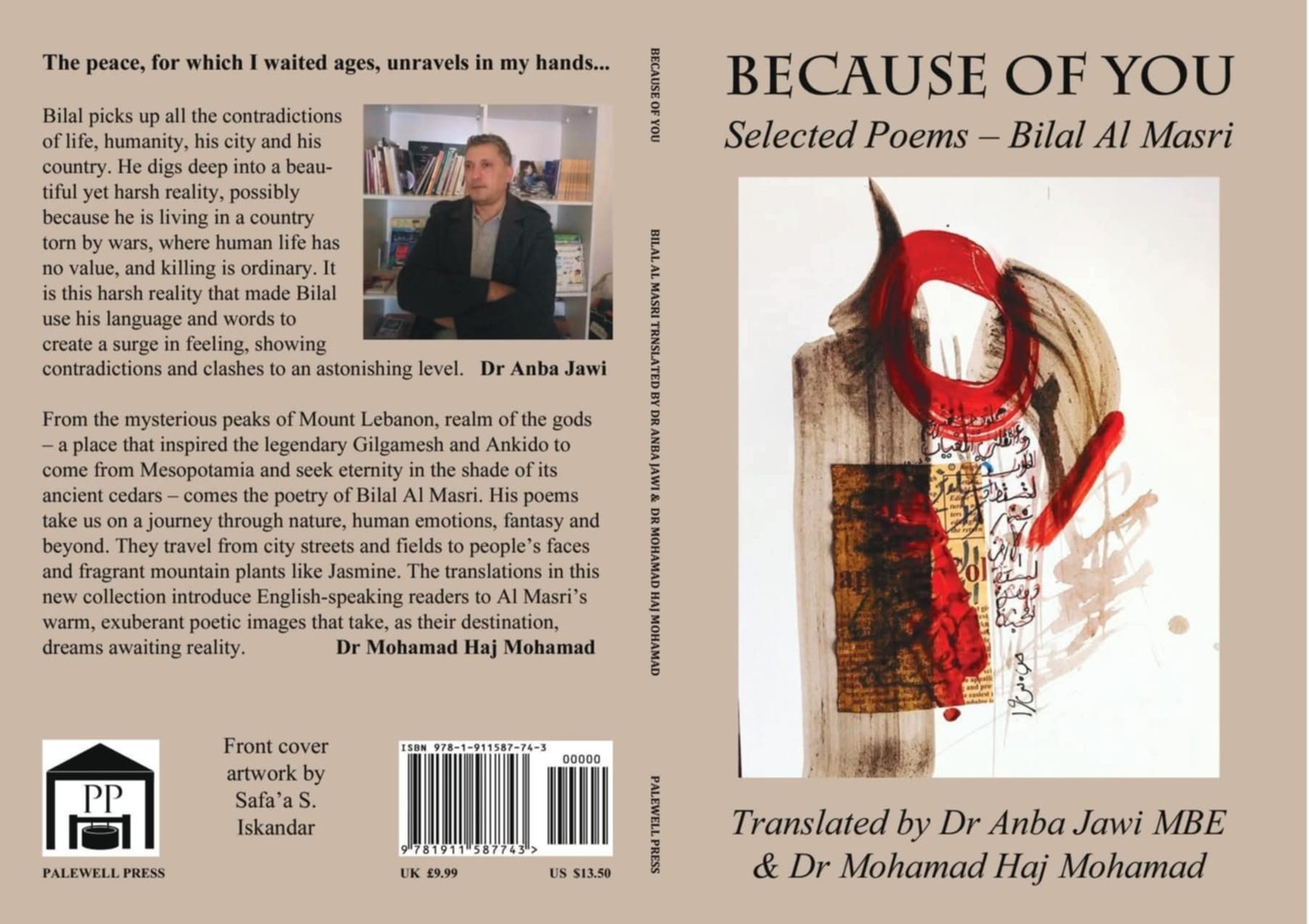
Bilal Al Masri is a Lebanese poet and novelist, and while going through his poetic collection, ‘Because of You’, I felt I was not in front of a normal assemblage of poems which could be read apiece, understood and written about, or even summarised followed by a central idea. As I opened the first poem, I realized I was engaged in a guerrilla warfare, marked by landmines. Poems had their face on the other side, sometimes they would walk for a few feet, then start walking back, on the same feet. Some of them had twisted feet, like ghostly figures. Was I reading modern poetry, or it was too modern, or I was in the macabre world of Gothic times, with its romantic antechambers of uncertainty, making the reader breathless, for he cannot be sure what he will be treated to in the coming line. If you understand one sentence, the next could turn the entire thing over its head.
Before I come to Bilal Al Masri, the basic question before us is: How we access poetry. Poetry has never been a smooth affair, nor were Poets treated like normal men. No poem of substance would leave you without leaving its venom or wisdom inside your blood stream. After giving one or two readings to a poem, we often try to analyse it. In fact, poetic creation is an inexact, rather mysterious art, and then, understanding it is still more mysterious, because now two personalities clash and the final outcome cannot be uniform. According to theory of bio-text, if a few minutes more had passed, the poet would not have written the same poem, and if the reader had accessed the poem five minutes later, he would not get the same understanding. It is how biography or personal circumstances of both the people affect the creation and appreciation of poetry.
Poetry is an abstract art. Neither the poet knows which emotion he wants to express, nor the reader can reach the ranges from which he brings up that emotion. It is only from the venom left behind that we realise something serious has happened between the poet and his reader. In fact, if you want to say something clearly, write an article. If you want your subject matter to attack you, turn to poetry.
The Third Dimension
Ordinarily, Poetry brings an emotion to life. The power of the poet rests in his ability to transfer the metaphor onto to the paper, and make its intense formation transparent. But there is a third situation also in which poetry attacks the mind of the poet, takes him over and starts ruling over his imagination. It is not the poet who is writing the poem, it is the emotion which has cast a spell on the poet, and dictates him what to write. Who is the better poet? One who commands poetry or the one who is ruled by the poem? In these poems by Bilal Misri, I find this primeval duel between the poetry and the poet in its extreme manifestation.
Part II
A very serious tone grips the poems from the very beginning. The guerrilla warfare starts with the opening story itself, ‘A Story’ where words have assumed a distance, the characters don’t know, nor the author, which way to turn, though the poet warns us not to ignore the unimportant characters, the passers-by who make the pyramid.
If flowers wither in a book, or a woman throws herself beneath a train - these are acts of liberation. If love consumes the lovers, it is all fine, but they must not create children because this world is not good for them. The poet makes a passionate appeal to take care of the kids who are orphaned in the war. The war consciousness intervenes even in the happy moments the poet encounters.
‘Be sympathetic’ is a tough story, which wants sympathy flows through the words, let these words “re-inspire you to write stories/with neither thirst nor hunger in them”. A ravaged consciousness seeks empathy from words, while the environs are devastated by hatred, rivalries and political ambition.
‘I Love You’ leaves a powerful message for peace without borders, but the way it does is quite unsettling. Certainty is a dangerous thing, the poem avers, and warns: “Remember, /If love’s light leaves your heart/you will be bound for Hell”. Even in hell, your movement should be “towards peace without barriers’.
‘Follow Me’ talks of an invisible presence, ‘Without Me’, catches the irony of existence: people do not realise they are just made from dust and ‘Darkness’ celebrates equipoise even in the face or defeat: “Were you to draw a thousand suns/ you wouldn't banish darkness”. ‘Squabbles’, philosophises innocence, tells the story of being porous and transparent, reposing faith in childhood and its innocence. A highly evocative poem, My Mother, takes us deep into the consciousness of the poet, where he can hear the songs which dwell in seashells, and how his mother had taught him, and he too will teach this art to his children, “how to handle water without injuring the waves”. The poet appears to refer to the art of being alive, without injuring or exploiting the cosmic spread.
‘The Ring’ is a highly postmodern poem, which gives voice to the duality of expression as well as the poetic encounter. Here I find poetry attacking the poet and crippling him in the process: “The Genie fashioned wings for him but left him crippled’. He has the power to fly in the world of imagination, yet, his body is crippled because of the socio political conditions. Wings here are a mixed blessing, which empower and disempower at the same time.
‘The Witch’ is a surrealist poem, in which the things that happen strain logic, or heighten it to an exalted space, violating all linearity. A new type of imagery evolves which strikes and then silences: “Her mouth is like a fish swimming in a bowl of silence”. There is “a tattoo upon her back. Every time she scratches it, lightning strikes my soul”. The poet’s imagination leads us into strange states of poetic imagination, eerie yet tempting where words instead of giving out, prefer to keep the secrets intact. Rather than expressing the emotion, they choose to mystify the reader.
‘Maturity’ is an extraordinary poem, stunning at phrase construction: ‘acid bath of doubt’, ‘home becomes his home, on which he may choke’. Can bulldozers be swallowed? Even Donne cannot envision such an unsettling construct, who is famous for “yoking together” disaparate elements of experience. ‘Tears’ is a searing critique of modern living, marked by heartlessness, cruelty, helplessness and indifference. The dark images of mice hiding in a woman’s ears, her hair falling like snow-flakes. —all these appalling comparisons construct a weird emotional landscape. It is a crude state of self-centred existence, where people “are wandering along the paths, crushing each other’s hearts”.
It is no easy poetry, nothing poetic, only gothic, nothing romantic, only traumatic, depicting a life which is lived most unwillingly, something forged and then forced upon the people.
Jasmine rises like Bullets, [Bread resembles a stab-wound] And Because of you, [“A thousand reasons to love you, because in a desert of nostalgia, … you wreck me with desire, you light fires in my dry grass and then you leave”] What has the violin done to you [“Your hands are banks of a river of longing, and I breathe you. You are like death. After you, I have no idea what will happen to me”].
‘The Treasure’ turns traditional depictions over its head.
A poem which confronts and derails your mind with its startling comparisons, again brings Donne to mind, the talk of hemispheres now loses its romance, and earth looks like a morsel in the mouth of the universe which is ever expanding. “The search for paradise is nihilistic, yet there is hell of questions about it”, consoles the poet only himself, leaving the reader in the lurch.
‘Words’ is perhaps the best example of Bilal’s poetic craft. His power to bring together the romantic and the tragic, or rather, turning the romantic into weird. I could not believe a poet could treat his words with such bitter passion. But this also forces the reader to feel sympathy for the beleaguered poet, who has to attempt such a devastating critique of the entire modern civilization which is constructed with the help of language:
Words whose skirts do not fly up
to reveal the meaning at the core of life and make us cry,
are merely words.
Words that won’t undo their tops to breast-feed passers-by
till they’re satisfied,
are merely words.
Words that don’t betray their meaning, but use instead absurdity,
are merely words.
Words that would never cause
a back-street conflagration,
for all their synonyms and antonyms, are merely words.
Not easy to contend with this poetry. Yet it is before me, and before the world. I can only say it disturbed me a lot. And this disturbance is going to stay. If Bilal Al Masri’s poems succeed in causing this stir, as they have done to me, he has succeeded in his mission, to shake the world with the power of his words. Congratulations!
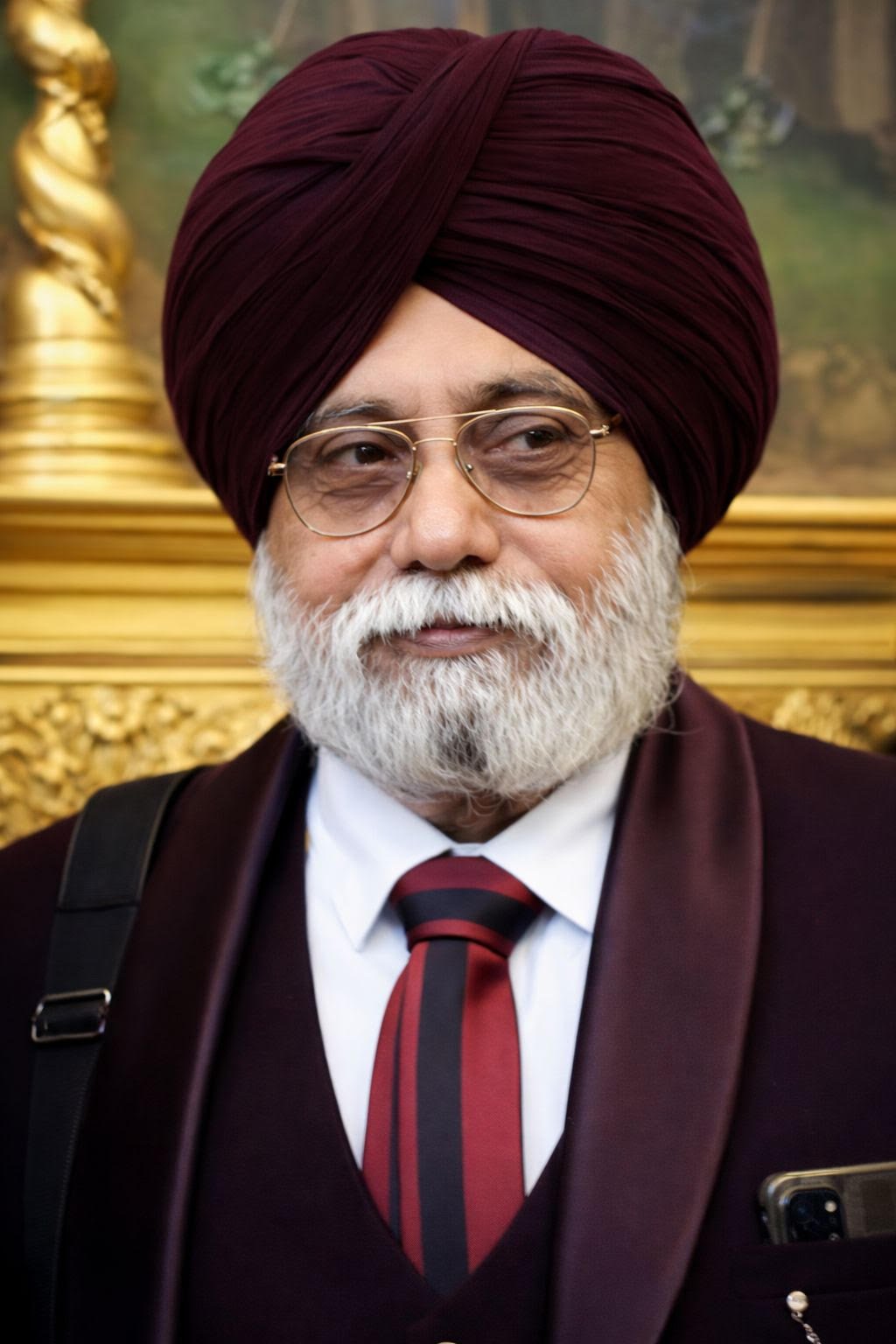
Dr. Jernail Singh Anand
Poet and Philosopher,
President, International Academy of Ethics.
Email: anandjs55@yahoo.com.
Whatsapp: 91-9876652401
[Dr. Jernail S. Anand, with 200 books to his credit [18 epics] is a Chandigarh-based top ranking presence in the contemporary world literature, a polymath, and a vital architect of the 21st century ethical literature whose seminal work ‘Lustus: The Prince of Darkness’ challenges the moral complacency of our era. Founding President of the International Academy of Ethics, and Laureate of Charter of Morava [Serbia], Seneca [Italy], Franz Kafka [Germany, Ukraine, Czeck Rep] and Maxim Gorky [Russia] Soka Ikeda and Mahakavi Bharati (India) Awards, his name is inscribed on the Poets’ Rock in Serbia. He is an Honorary Member of the Serbian Writers Association, Belgrade, a Member of the Honorary International Boule and Honorary Academic Senator of International Academy of Rome, and a Academic Member of the Academy of Arts and Philosophical Sciences, Bari [Italy], Lifetime Vice President of Korean Association of World Literature. He is International Honorary President of COLOSSEUM, International Literary Prize 2026 by International Academy of Rome.
Anand has built a poetics that unites ethics, Vedic spirituality, social critique, and the philosophy of meaning. Anand presents an articulated perspective on poetry as an instrument of planetary consciousness. A moral philosopher, professor, and international speaker, Anand has devoted much of his research to the ethical dimension of language, to the responsibility of the individual within a globalised society, and to the relationship between matter, consciousness, and transcendence. Email: anandjs55@yahoo.com.
Bibliography:
https://sites.google.com/view/bibliography-dr-jernal-singh/home
Grokipedia:
https://share.google/QtiWrcFr7Sca7v0qC




 English
 Afrikaans
 Arabic
 Bengali
 Bulgarian
 Chinese (Simplified)
 Dutch
Dutch Filipino
 Finnish
 French
 German
 Greek
Greek Hausa
Hausa Hindi
Hindi Hungarian
 Igbo
Igbo Italian
 Japanese
 Korean
 Malay
Malay Malayalam
 Polish
 Portuguese
 Punjabi
 Romanian
 Russian
 Serbian
 Slovak
 Spanish
 Swahili
 Ukrainian
 Urdu
Urdu Yoruba