
An Interview with the Palestinian-Canadian Poetess
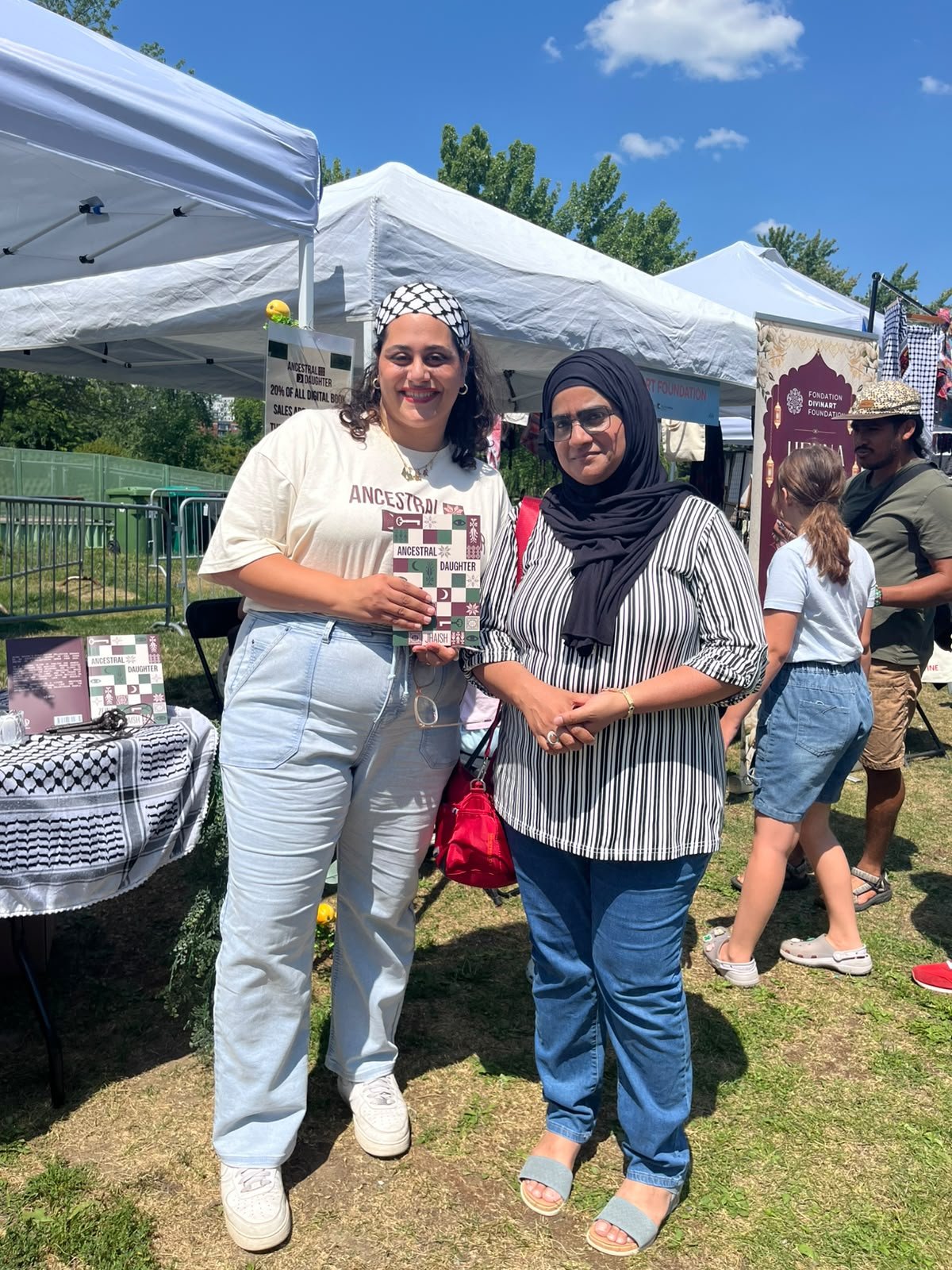
While many people are talking about the war in Gaza and protesting against genocide, I became curious to learn what Palestinian-Canadian poets had to write about their homeland. I met Zeina Jhaish at the Palestine in the Park event, an annual two-day cultural festival in Montreal, Quebec, held on July 25 and 26, 2026. I met Zeina there and bought her poetry book, Ancestral Daughter, published by Daraja Press.
Her poems deal with her own feelings and stinging pain for her people in Gaza. They reveal her generational love, personal anguish, and admiration for the Palestinian martyrs and for those who are forced to undergo trauma, yet remain determined to hold their heads high with courage and dignity. After reading her powerful verses, I felt a strong need to interview her.
We finally met at McGill University's Redpath Library to talk about the poetess and her book, Ancestral Daughter. Zeina Jhaish explained that her poetry collection depicts duality. The title Ancestral Daughter can be divided into two parts, whereby Ancestral reveals her identity as a Palestinian, while Daughter reflects her current identity in Canada, her present status, and sense of self.
Although Jhaish was born in Canada, her heart identifies strongly as Palestinian. She visited her ancestral city, Gaza, twice and lived in Kuwait when she was younger. The poetess has always felt a strong attachment to her roots. She admitted during her interview: "When you are Palestinian, you always feel the sense of belonging there." However, Jhaish loves Montreal because she "feels more Palestinian here" and has met Palestinians from all "walks of life" in the city. She believes that Canadians are in favour of social justice, although some may hold different beliefs. However, this does not prevent her from acknowledging that people in Montreal are warm and welcoming.
Jhaish claims that she writes poetry when she is in the mood to write; thus, her poems come from a place of presence rather than forced intellectual demand. "For me, it started as an outlet as I talk about something from personal experience," she said. This is why her poems are raw and filled with both hope and despair, reflecting the duality that permeates her work. The poetess finds it important to write because there are so many lives being lost in Gaza every day. This makes her restless, and her Palestinian identity cannot be ignored. The poetry collection is a mirror of this powerful identity.
Her poems employ modern poetic techniques. They are accessible and yet poignant, immersing readers in their emotional landscape. As human beings, we cannot ignore the burden of loss and genocide:
I refrain
From touching
My hair
I refrain
From remembering the origins
Of my hair
My roots
To maintain
My heart
To keep it at bay
To maintain
Its safety
And my legs walk
Across another sea
To find other roots
My feet land
On a plant
Crushed
There are no roots
There is no way
And I refrain from
Watering up
An olive tree
I refrain from
Touching my hair
(Poem from Ancestral Daughter, p. 31)
As Jhaish mentioned during her interview, her metaphors come naturally, as illustrated by the olive tree in this poem. Refraining from touching the hair refers to avoiding contact with it so as not to be reminded of one's family roots. The poet's roots are in Palestine, and the olive tree becomes both a literal and symbolic image. In the Quran, particularly in Surah An-Nur (The Light Verse), the olive tree is described as blessed because it symbolizes God's light and belongs neither to the East nor the West. In this sense, it represents spiritual guidance that transcends geographical boundaries.
Jhaish's poems reveal her concern for Gaza, yet the speaker cannot express it directly. The poem speaks indirectly about the poetess's roots as she refrains from touching the hair that would reconnect her to them. However, the country where the olive tree stands, namely Palestine, is being embraced by people throughout the world today. Just as the olive tree in the Quran belongs neither to the East nor the West, concern for Palestine transcends borders and belongs to humanity. Jhaish herself acknowledges throughout her collection that people around the world are standing in solidarity with Gaza.
Jhaish's message to Palestinians is one of hope through education, which she considers the key to success. She is a proud young Palestinian woman who graduated from a Canadian university. For her, education empowers people, and she is pleased that Gaza has a high literacy rate. She asserted: "If I get to Gaza, it will be an honour. I'd teach Gaza resistance literature."
Poetry writing comes naturally to the poetess, as she loves lyrics and enjoys studying how they connect to music. According to her, all forms of literature are powerful because films, music, and poetry are interconnected. "Poetry calls for an emotional reader response because it has more cognitive power," asserted Jhaish.
In her poetry collection Ancestral Daughter, she included four poems in Arabic, while approximately ninety-five percent of the book is written in English. The poetess chose to write her romantic poems in Arabic, but she preferred to express her thoughts on the Gaza war and political issues in English. Although English was used as a language of colonial influence in Palestine, she chose to write in it because it is a global language through which she can communicate her thoughts about her homeland to a wider audience.
Shah Jehan Ashrafi
Quebec,  Canada
Canada



 English
 Afrikaans
 Arabic
 Bengali
 Bulgarian
 Chinese (Simplified)
 Dutch
Dutch Filipino
 Finnish
 French
 German
 Greek
Greek Hausa
Hausa Hindi
Hindi Hungarian
 Igbo
Igbo Italian
 Japanese
 Korean
 Malay
Malay Malayalam
 Polish
 Portuguese
 Punjabi
 Romanian
 Russian
 Serbian
 Slovak
 Spanish
 Swahili
 Ukrainian
 Urdu
Urdu Yoruba