
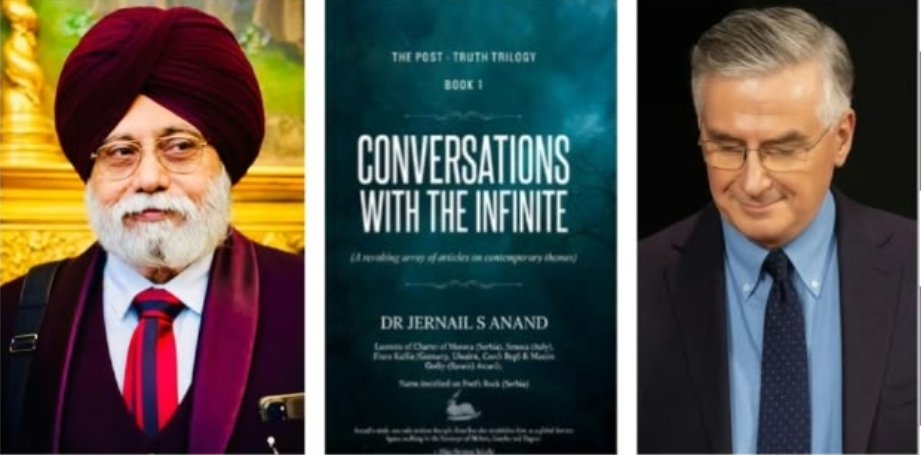
Introduction:
A book that exists in the present and outside of time.
Not being a collection of articles in the journalistic sense of the term, this text defies any conventional classification.
It is neither an academic essay nor a philosophical treatise.
As stated by the author himself:
it is "just a conversation over evening tea."
As a matter of fact, a rhetorical strategy is hosted within this modest declaration.
Conversations with the Infinite has a complex and speculative structure.
Its edifice interweaves:
spirituality and technology, ecology and pedagogy.
But also:
metaphysics and cultural anthropology;
social critique and moral philosophy.
The book is a patchwork of reflections.
Yet, its internal framework is surprisingly compact.
Each chapter is a quilt of patchwork that contributes to a larger plan:
that one of the ethical regeneration of humanity.
Anand doesn't simply diagnose the ills of the present;
he proposes a way out, a cure, a journey of moral reconstruction that involves the individual, society, technology, and the cosmos.
His writing is simple, but never simplistic.
It is communicative, but not banal.
It is accessible, but does not sacrifice depth.
It is, above all, a writing that seeks to touch the reader, trying to shake him, and restore the awareness of his role in the world.
The book is an eminently ethical work.
It judges the world, it does not describe it.
It questions reality, it does not observe it.
It proposes, it does not merely denounce.
The Conceptual Framework: The Crisis of the Post-Truth Era
The subtitle of the trilogy to which this book belongs—The Post-Truth Trilogy—is already a manifesto.
Anand identifies post-truth as an anthropological condition, not just as a media or political.
Contemporary man has lost touch with truth, with reality, with his own interiority, with nature, with time, with community, with the divine.
Post-truth, for Anand, is not an epistemological problem:
it is a moral problem.
It is the consequence of a series of fractures:
the fracture between knowledge and wisdom;
the fracture between technology and humanity;
the fracture between education and moral formation;
The fracture between the individual and society;
The fracture between man and nature;
The fracture between human time and cosmic time;
The fracture between interiority and social representation.
The book is an attempt to heal these fractures, to mend what modernity has torn apart.
The diagnosis:
Contemporary man as a "neo-slave"
The first two chapters are dedicated to the transformation of work in the digital age.
A powerful historical parallel is constructed by Anand.
The digital worker who lives "chained to his cell phone day and night."
From ancient slavery, to feudal servitude, to the condition of the industrial worker, to the new figure of the laptopicarian.
3.1. Digital Slavery as Historical Regression
Anand argues that technology, instead of liberating humanity, has re-chained it.
Workplace flexibility is a fiction:
the digital worker is always available, always monitored, always evaluated, always under pressure.
They no longer have fixed hours, no longer have boundaries between private life and work, no longer have union rights, no longer have security.
Technology, which should have been a means, has become a master.
3.2. The Loss of Dignity
The central point of Anand's critique is not economic, but anthropological:
the digital worker has lost dignity.
He is a node in a network that monitors and exploits him, a terminal, a cog.
He is no longer a political subject, no longer a worker with rights, no longer a citizen.
3.3. The Condition of Teachers
Particularly incisive is his denunciation of the condition of teachers, "once the most dignified sector of society," now reduced to executors of bureaucratic tasks, deprived of time to think, reflect, create, and educate.
Anand hits on a key point:
when teachers lose their dignity, the entire society loses its own.
The Second Fall of Man: The Loss of "Human Graces"
A powerful concept is introduced by Anand in the third chapter:
the second fall of man.
The first fall, the biblical one, was the fall toward knowledge.
The second, the contemporary one, is the fall from human grace.
4.1. Emotional Disintegration
Being emotionally disintegrated, modern man lives in a world of material comforts, but is internally restless, confused, and empty.
Technology has reduced the capacity for discernment, even if it has amplified possibilities.
Far from being a solution, one perceives AI as a threat.
4.2. The Ethical Neutrality of Literature
Contemporary literature has abdicated its moral role.
This crucial cultural phenomenon has been denounced by Anand.
Writers no longer want to assume ethical responsibilities, no longer want to point to good and evil, no longer want to take a stand.
They fear being accused of moralism.
But this neutrality is, for Anand, a form of complicity with moral chaos.
4.3. The Proposal:
"Etiquettes"
Anand’s proposal is that its ethical purpose should be explicitly stated by every literary work.
This is not propaganda, but cosmic responsibility:
the writer must contribute to the good of the universe.
The Metaphysics of Time:
Kaal and Maha-Kaal
The fourth chapter is one of the most profound and original.
Anand distinguishes between:
Kaal, human, finite, mortal time;
Maha-Kaal, cosmic, eternal, divine time.
5.1. Man as an Uninitiated Being
Man arrives on earth "uninstructed and uninitiated":
he ignores that his actions have cosmic consequences, that he is being observed, and he ignores as well the reason why he is here.
He lives as if he were eternal, but he is a temporary traveler.
5.2. Cosmic Surveillance
Maha-Kaal, symbolically associated with Shiva, observes every action, every thought, every intention.
He does not judge according to material evidence, but according to spiritual DNA and karma.
5.3. Man's Cosmic Responsibility
Anand invites the reader to live with awareness of his cosmic role:
every action is recorded, every choice is evaluated, every life is part of a greater plan.
Deep Psychology: The "Digestive Tract"
The fifth chapter is a meditation on the structure of human consciousness.
Anand distinguishes three levels:
the formal, social, performative level;
the "underpass," the interior level that protests against the falsity of the formal level;
the "Digestive Tract," the place where man judges himself before dying.
6.1. The Division of the Self
Man lives divided:
what he shows does not coincide with what he feels.
This division produces confusion, suffering, and moral ineffectiveness.
6.2. The Last Judgment as Self-Judgment
Anand argues that before dying, man knows perfectly well what he has done, what he has done wrong, what he has betrayed.
He carries with him his own judgment, which anticipates the divine one.
6.3. The Superiority of Nature
Nature does not have this division:
it is unitary, wise, and coherent.
On the other hand, humans are torn by ambition and knowledge.
The Educational Revolution:
Against the "Bottling Plant Syndrome"
Chapters 6 and 8 are devoted to a critique of the contemporary education system.
7.1. Time as a Wasted Resource
Anand denounces the absurdity of a system that forces extremely fast students to follow extremely slow paths.
School has remained stuck in the era of camels, while children live in the age of AI.
7.2. The Loss of "Vacant Time"
Free time, empty time, contemplative time has been eliminated. But it is precisely in that time that creativity, philosophy, and wisdom are born.
7.3. The University as a Factory
Universities have become "bottling plants":
they produce students as products, with labels and prices.
Moral education has disappeared.
AI as a Jinn: the most visionary chapter
The seventh chapter is a masterpiece of philosophy of technology. Anand compares AI to the Jinn in Aladdin's lamp:
immense power in the hands of an immature man.
8.1. Assistance vs. Abdication
AI is useful when it assists;
it is dangerous when it replaces.
Man risks becoming a child cared for by the machine.
8.2. The "Fake Factory"
Anand denounces the production of fake human beings, fake speeches, fake leaders, fake worlds.
Reality becomes an option, not a foundation.
8.3. The Three "Ethical Commands"
Anand proposes three ethical commands for AI:
Ecological:
Heal what humans have wounded.
Social:
Serve workers, not replace them.
Existential:
A world without fossil fuels be invented.
Moral Reconstruction:
Against Ethical Inertia
The ninth chapter is a call to youth:
recover truth, sincerity, and kindness.
Anand distinguishes between religiosity (external) and ethics (internal).
Society has confused the two, losing both.
Natural Wisdom: "Wisdom Farming"
The tenth chapter is a defense of nature considered as a teacher of wisdom.
Humans have forgotten that wisdom, possessed by mountains, plants, rivers and animals.
Criticism of Contemporary Poetry
In chapter 11, Anand denounces narcissistic, self-referential, and messageless poetry.
Poetry should "whisper to the soul," not recount the fragments of a broken heart.
Happiness as a Social Construction
Chapter 12 is a reflection on happiness:
it is not an individual fact, but a relational one.
It does not arise from possession, but from sharing.
Macbeth and Poetry as a Cure for Darkness
Chapter 13 imagines a Macbeth who, if he had read poetry, would have avoided evil.
Poetry is an antidote to moral darkness.
Time as a Cosmic Laundry
Chapter 14 is a meditation on time:
past, present, and future are rivers that meet.
The present is the laundry where actions are purified.
The Returning Truth
Truth as an inexorable force.
It strikes whenever it wants.
Anand clarifies that in chapter 15.
But false narratives can last for generations.
The Jungle as a Model of Order
Chapter 16 overturns the concept of "jungle raj":
the jungle is more orderly, more just, more balanced than the human world.
The Cosmic Regeneration of Humanity
A call to arms is evident in the final chapter.
Scientists, writers, and philosophers should gather.
They’d have to work jointly to save humanity from suicide.
Conclusion:
A Necessary Book
Conversations with the Infinite is a necessary work.
Not because it offers simple solutions, but because it reminds humanity of its complex, cosmic, and moral nature.
Anand is an author who doesn't simply describe the world:
he wants to save it, fears it, loves it, and judges it.
The book is an invitation to remember that we are part of a living universe.
A living universe that awaits us, judges us, accompanies us, and observes us.
As well, the text is a call to feel, to think, to slow down.
It's a book you don't read:
you listen to.
It's a book you don't study:
you meditate on.
It's a book you don't forget:
you carry it with you.




 English
 Afrikaans
 Arabic
 Bengali
 Bulgarian
 Chinese (Simplified)
 Dutch
Dutch Filipino
 Finnish
 French
 German
 Greek
Greek Hausa
Hausa Hindi
Hindi Hungarian
 Igbo
Igbo Italian
 Japanese
 Korean
 Malay
Malay Malayalam
 Polish
 Portuguese
 Punjabi
 Romanian
 Russian
 Serbian
 Slovak
 Spanish
 Swahili
 Ukrainian
 Urdu
Urdu Yoruba