
The following written proposal was submitted to me by Dr. Tanvir Ratul, Professor, Computational Linguistics, City of Liverpool College and Director, Centre for New and International Writing, concerning the education system in Bangladesh. Bangladesh has been under duress this year following mass student protests beginning in 2024. The protests broke out over consolidation of power by the ruling Awami League. Following mass youth unemployment and economic hardship, the 2018 reform that abolished strict quotas for government jobs (30 percent reserved for descendants of freedom fighters) was restored in 2024. Prime Minister Sheikh Hasina was forced to flee the country. Government violence led to repression of dissidents, the deaths of over 1,000 people including students, and destruction of property including media houses. The philosophy inherent in the proposal resembles the views of American progressive humanist and education reformer John Dewey who wrote, “Give the pupils something to do, not something to learn; and the doing is of such a nature as to demand thinking; learning naturally results.” I am also reminded of Henry David Thoreau's Concord Grammar School Experiment that laid the foundation for later anti-utilitarian education in the United States. Thoreau wrote, “We seem to have forgotten that the expression ‘a liberal education’ originally meant among the Romans one worthy of free men; while the learning of trades and professions by which to get your livelihood merely, was considered worthy of slaves only. But taking a hint from the word, I would go a step further and say, that it is not the man of wealth and leisure simply, though devoted to art, or science, or literature, who, in a true sense, is liberally educated, but only the earnest and free man.” Many thinkers such as Paulo Freire of Brazil share this humanistic vision.
- Dustin Pickering, editor at World Inkers Printing and Publishing.

Henry David Thoreau
To,
UN Special Rapporteur on the Right to Education (Ms Farida Shaheed)
(ahead of her official country visit to Bangladesh, 23 November–4 December 2026)

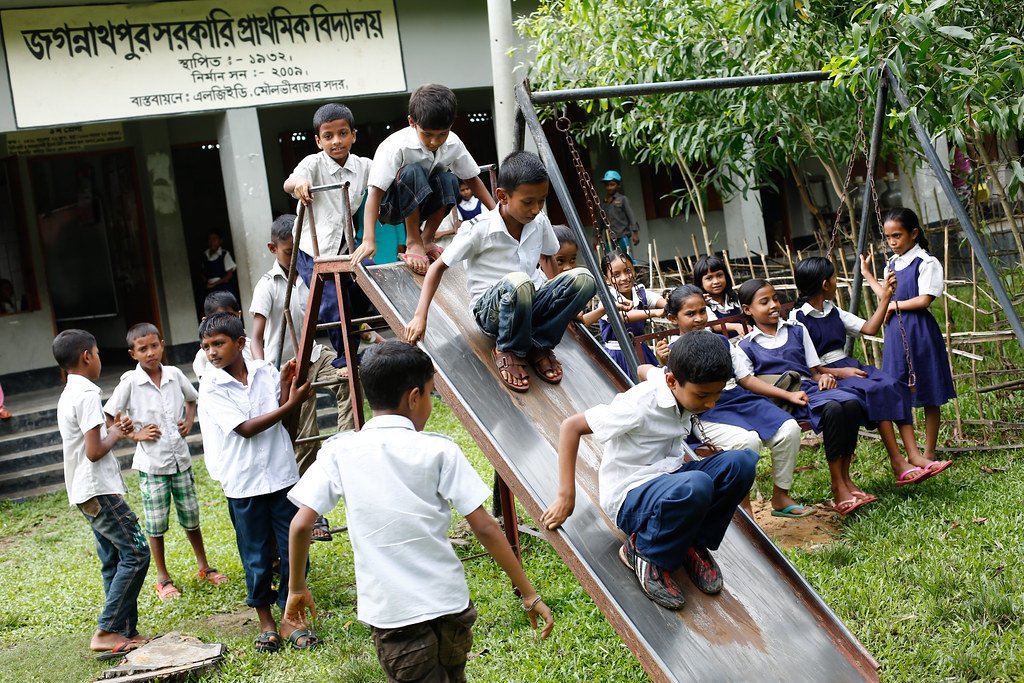
Bangladeshi primary school students. Image taken from HuffPost.
In Bangladesh, a child goes to school. In the morning, the child puts on a uniform, packs books and notebooks, and sometimes travels a long distance before sitting in the classroom. The teacher writes on the board, and the students copy it into their notebooks. Some listen attentively, some memorize, and some think about the examination. The bell rings. The class ends. But one question remains—“Did the child really learn?” Going to school and learning are not the same thing. Being present at school may be the first condition for learning, but it is not the final word. A child may be able to read a book and yet may not understand its meaning. A child may memorize mathematical formulas and yet may not be able to apply them to problems in real life. A child may be able to write English words and yet may not be able to express their own thoughts clearly.
The expansion of participation in primary education in Bangladesh is undoubtedly an important achievement. But the crisis of learning still remains. According to the World Bank's 2024 data, approximately 51 percent of children in Bangladesh at the end of primary-school age cannot read and understand an age-appropriate piece of writing. This is not merely a statistic. Behind it are many children who attend school year after year, sit for examinations, and move from one grade to another—but do not fully acquire the ability to understand what they read, the joy of asking questions, or the ability to connect their learning with life. Our first question to the state is—“Are we merely bringing children into schools, or are we also turning them into people who learn?” To find the answer, we must return to the classroom. Because education first takes place in the classroom. It is there that a child gradually begins to learn—what knowledge is, what ignorance is, how much a question is worth, whether one has the right to make mistakes, how much one has the right to express one's own thoughts, and whether the world will remain as it is or can be changed. A classroom, therefore, is not merely a place enclosed by four walls. It is a social world. There is a teacher there, there are students, there are books, there is language, there is power, there is memory, there is difference. There are some voices that are easily heard; and there are also voices that remain silent.
In many classrooms in Bangladesh, the teacher is still the principal speaker of education, and the student the principal listener. The teacher speaks, the student listens. The teacher asks questions, the student gives the answer from the book. The teacher writes on the board, the student copies it into the notebook. Then comes the examination. Through this method, a certain amount of information can be delivered quickly. But is education simply the delivery of information? If we think of a student's mind as an empty vessel, then the teacher becomes the person who pours knowledge into that vessel. The more the student receives, the better. But a human being is not a vessel. A person has experiences, memories, imagination, feelings, and questions. A person does not merely receive; a person also creates meaning. Therefore, if we see the student merely as a consumer of knowledge, education becomes one thing. If we see the student as a partner in the construction of knowledge, education becomes something else. When a child asks a question, they are not merely seeking an answer. They are creating a relationship with the world. When a child asks, “Why does it rain?”—they do not merely want to know the scientific answer. They want to understand the world. When they ask, “Why is the river in our village drying up?”—there is not merely geography; there are questions of the environment, agriculture, livelihood, and economics. When they say, “My father works all day, yet why is there not enough money in our household?”—there is not merely the matter of family finances; there are questions of labour, income, and society. If education stops these questions and merely makes children memorize the answers from books, then we are not giving children knowledge; we are teaching them to remember answers. The work of education is greater than that. People read the world before they read words. A child reads their mother's face, reads their father's exhaustion, reads the deprivation at home, reads the roads of the village, reads the flow of the river, reads the smell of rain. Later, they learn the words of books. Those words can then help them understand the world they already knew more deeply. Therefore, reading does not mean merely recognizing letters. “Reading also means learning to understand the meaning of reality.” This idea is particularly important for education in Bangladesh.
For a coastal child, a cyclone is not merely a chapter in geography. Their family's home may have been damaged by the storm. Their father may have lost crops because of saline water. For a child of the haor wetlands, the monsoon is not merely the name of a season. Going to school, the family's income, and crops—all are connected to water. For a child of the chars, the river is not merely a blue line on a map. The river is sometimes a livelihood, sometimes erosion, sometimes the memory of losing a home. For a child in Dhaka, the environmental crisis is different again—traffic congestion, air pollution, noise, waterlogging, and the lack of places to play. Then, is it enough to teach the same subject in the same way to everyone? Giving everyone the same book may be one condition of equality. But it does not mean that everyone will learn in the same way from the same book. Because children come to books carrying their own lives with them. A child does not come to school empty. A child from a village in Bangladesh knows about crops by observing the nature of the soil. A fisherman's child understands the current of the river. A shopkeeper's child knows arithmetic. A farmer's child understands the relationship between seasons and seeds. An urban child comes with experiences of markets, traffic, technology, and urban life. Are these not knowledge? The school cannot in any way replace these experiences. But if the school does not even recognize them as knowledge, then education is provided by disconnecting the student from their own life.
Suppose a child is flying a kite. They do not know the words “angle,” “ratio,” or “trigonometry.” But they know through experience when to release the string, when to pull it, and what the relationship is between the kite and the wind. If the teacher creates a connection between the child's experience and mathematical formulas, then mathematics leaves the pages of the book and enters life.
Then the child understands—“What I know is not outside knowledge.” This is a profound realization for education. Because a child who believes that their own life, language, and experiences have no value gradually learns to doubt their own knowledge. The work of education, therefore, is not merely to give children new knowledge. Helping them recognize their own knowledge is also education. However, this does not mean that the teacher will step back and allow the child to do whatever they want. Rather, the teacher must become even more attentive. They must observe what the child is doing, how they are thinking, where they are getting stuck, and in which activities their interest is growing. Therefore, the teacher must not only study the subject; “the teacher must also read the student.” They must read the student's silence. They must read mistakes. They must read questions. They must read the reasons for absence. They must also read whether there is fear in the child's eyes, whether there is interest, and whether there is confidence. It is not enough to label a child as a “weak student” and stop there. Rather, we must ask—“What kind of support would enable them to go further?” A child may not be able to do something independently today. But with a little support, they may be able to do that work independently tomorrow. The teacher's responsibility is to see that possibility.
At this point, we need to rethink the relationship between teacher and student. The teacher knows some things that the student does not know. Again, the student knows some things that the teacher does not know. This mutual incompleteness is the possibility of education. Therefore, the teacher must say—“I know—but I do not know everything.” There is no weakness in this statement. Rather, this is where the teacher's intellectual honesty lies. When a teacher says, “I don't know; come, let us find out together,” they do not lose their authority. They give authority a different meaning. Because authority and domination are not the same. Domination says—“I am the teacher, therefore my word is the final word.” Responsible authority says—“I am the teacher, therefore it is my responsibility to help you move forward on the path of learning.” A teacher's authority is necessary. But if that authority silences the student's voice, then it does not advance education. And if authority creates the courage to ask questions, then it becomes a source of educational strength. This is where mutual dialogue becomes essential. Dialogue does not mean that the teacher and student will simply take turns speaking. Dialogue means recognizing one another as knowledgeable human beings. The teacher should not merely speak “to” the student; they should speak “with” the student. Educating with a child and imposing education upon a child are not the same thing.
In Bangladesh's examination-centered education system, this distinction is often lost. Children are told—study this chapter, memorize the answer to this question, and if you write it this way, you will get marks. As a result, students gradually learn that the purpose of knowledge is to obtain marks in examinations. But knowledge has another purpose—“to make people conscious of their own reality.” Suppose a child cannot attend school regularly. We may say, “They are not attentive to their studies.” But we can ask further questions. Do they work? Is there financial hardship in the family? Is the school far from their home? Is their journey to school safe? Do they have a place to study at home? Are they studying in a language that is unfamiliar to them? These questions move the problem from the child's personal failure toward social reality. This is critical education. However, critical education does not mean denying everything. Rather, it means examining a subject together with its causes, history, effects, and alternatives.
“That's just how things are at our school”—this is a description. “Why is it this way?”—this is a question. “Could it be done differently?”—this is a question of possibility. And “What can we do to do it differently?”—here thought moves toward action. Merely understanding the world is not enough. Again, action without thought can also be blind. Education reaches fulfillment when understanding leads people toward meaningful action and that action, in turn, teaches them to think anew. If a child learns about river pollution, then observes the condition of a local river, collects information, discusses its causes, and takes a small initiative for cleaning it, then their education moves beyond the book and returns to reality. This does not have to be a major program. An investigation into stagnant water beside the school can also be education. Making a list of local trees can also be science. Recording changes in market prices can also be mathematics and economics. Writing down history heard from elderly people in the village can also be the practice of history. Education then returns to life. If education remains confined only within examination halls, the child's relationship with the world becomes narrower. Nature, art, creativity, independent inquiry, and relationships between human beings are also parts of education. By keeping Bangladeshi children confined only to the world of books, we make their world smaller. A tree can be learned by sitting beneath a tree. Soil can be learned by going into the field. A river can be learned by going beside the river. History can be learned by listening to local history. Education does not always take place within four walls. At the same time, schools are not unnecessary. Rather, the task of the school is to connect children's experiences with broader knowledge. The school is therefore not the sole owner of knowledge; rather, it is a social institution for organizing, deepening, and expanding knowledge. In such a school, the teacher is also not merely a worker whose job is to finish the syllabus. Their task is to create questions, build relationships, and create connections between experiences and concepts. But for this, teachers must be given time, training, and a supportive environment. If a teacher is given only the responsibility of “improving results” while working under daily administrative duties, huge classrooms, limited time, and examination pressure, then it is difficult to expect liberating education from them. Teachers also have the right to learn. A teacher who does not read themselves, does not ask questions, and does not reflect on their own methods—how will they create in children a lifelong desire to learn? Therefore, teacher training is not merely a matter of memorizing new guidelines. Teachers must be given opportunities to think about their own classrooms. They must discuss matters with colleagues. They must analyze students' work. They must learn from mistakes. Teaching is not a profession learned only once. “The teacher is also a lifelong learner.”
A classroom can become a place where every student feels visible. A child should not feel—“There is no one here who will listen to me.” Because education becomes humane only when people are seen not merely as brains, but as complete human beings. A child has fear, joy, family experiences, and dreams. These cannot be pushed outside education while the child's brain is simply filled with information; but a human being cannot be educated in that way. This is why love is an important condition of education. Love does not mean abolishing discipline. Rather, it means giving importance to the student's potential. When a teacher says, “You cannot do it,” a door closes. When the teacher says, “You have not been able to do it yet; let's try again,” a possibility remains open. There is hope in the word “yet.” Hope does not deny reality. A child in Bangladesh who comes to class hungry cannot be freed from hunger merely by speaking to them about hope. A child from a family who is irregular at school because of work cannot have the problem solved merely by explaining the importance of attendance. Hope becomes a force only when it acknowledges reality and searches for the possibility of change within that reality. Therefore, education alone cannot solve all social problems. But education can prepare people to understand those problems and work toward changing them.
Humanity is also essential in the matter of language. The languages of children in Bangladesh are not all the same. Regional accents, words, and sentence patterns are part of their lives. Again, the mother tongues of many children from ethnic minority communities are not Bengali. Teaching standard Bengali is important. Learning English is also important. But teaching a new language does not mean belittling a child's own language. A child should be able to say—“This is my language. And I am learning this one too.” The more languages a child acquires, the larger their world becomes. Education should open doors; the doors of identity must not be narrowed. The culture of Bangladesh is not a single, fixed culture. Rivers, hills, coastal regions, chars, haors, villages, cities, labour, folk culture, and modern urban life—all together constitute its multilayered form. If a child's school does not reflect any part of this diverse reality, then education creates distance from their life. Education then says—“Your life is on one side, and knowledge is on the other.” We need an education that says—“A door to knowledge can open from your life itself.” This is where the teacher's role is most important. The teacher decides which stories will be told, which language will receive respect, which history will be discussed, and which experiences will be given the dignity of knowledge. Therefore, the teacher is not merely a transmitter of lessons. The teacher is also a creator of culture.
Self-criticism is also important for the teacher. Whom am I listening to? Whom am I not listening to? Whose language am I calling “correct”? Which experience am I dismissing as “the experience of the uneducated”? Who speaks easily in my classroom? Who remains silent? Why? These questions are also part of the teacher's own education. Because if the teacher cannot question themselves, how will they teach students to ask questions? Education, therefore, is not a one-way relationship. The teacher teaches the student, and the student also teaches the teacher. The teacher's dignity does not decrease through this mutual learning. Rather, the meaning of teaching becomes deeper. The teacher then does not say, “I have all the answers.”
They say, “Come, let us look at the question together.” This word—“together”—is the heart of democratic education. Democracy is not merely a system of voting. Democracy can also be practiced in the classroom—listening to others, expressing one's own opinion, tolerating differences of opinion, speaking through reason, admitting one's own mistakes, and recognizing the dignity of others. Even if this education is not separately written in books, it can be taught through classroom behavior. If the teacher waits until the student has finished speaking, the child learns to listen to others. If the teacher admits their own mistake, the child learns that mistakes are not shameful. If the teacher does not insult a differing opinion, the child learns that disagreement is not hostility. Education then does not merely provide knowledge; it also creates a democratic culture. This is important in Bangladesh's education. Because we want people who do not merely know how to follow instructions; who can question through reason, listen to others, and take responsibility for their own decisions. Therefore, education is ultimately an ethical act. Every day, the teacher faces a question—“Am I making the child feel small, or am I giving them room to grow?” Am I merely giving them answers, or am I also giving them the ability to ask questions? Am I teaching them to adapt to the world, or am I giving them the courage to understand the world and, when necessary, change it? The nature of education is determined by the answers to these questions.
The future of education in Bangladesh therefore does not depend only on new textbooks, new buildings, new examinations, or new technologies. These are necessary. But alongside them, we need the courage to change the philosophy of education. We cannot think of children as empty vessels. We cannot think of teachers as omniscient. We cannot think of examinations as synonymous with education. We cannot think of schools as the only places of learning. And we cannot think of knowledge as a resource whose owners are only books and teachers. Knowledge is created in people's lives, within relationships, through questions, inquiry, mistakes, conversation, and action. Education teaches people to recognize that knowledge, organizes it, deepens it, and opens new doors of possibility before them. In the end, education returns to a simple but profound question—“What kind of human being do we want to create?” Only a person who performs well in examinations? Or a person who can understand the meaning of their own life, respect the experiences of others, ask questions through reason, learn from mistakes, understand their own society, and think of reality as something that can be changed? This is where the true power of education lies. When a teacher listens to a child, it is not merely a student who is being heard—it is a world that is being heard. When they connect the child's experience with knowledge, it does not merely make a lesson easier—knowledge itself expands. When they say, “I don't know; come, let us find out together,” they do not lose their authority; rather, they transform education into a shared inquiry. And when a child learns to look beyond the book and question their own world, the most important work of education begins.
Because the world is not merely for reading. “The world must be read. It must be understood. Its power, inequality, beauty, and possibilities must be recognized. Then we must ask—could this world be different?” The hope of education lies within that question. When a child learns to ask this question, they are no longer merely a student preparing for examinations. They become a reader of their own world. And a person who learns to read the world can, one day, may one day write the world anew.
Ending Educational Apartheid: A Proposal for Universal, Scientific and Mass-oriented Education System in Bangladesh
Submission to the UN Special Rapporteur on the Right to Education (Ms Farida Shaheed) ahead of her official country visit to Bangladesh, 23 November–4 December 2026
Date: 13/09/2026
Submitted by: Bangladesh National Students' Assembly
1. Summary of Recommendation
We respectfully submit that the single most consequential reform available to the Government of Bangladesh in fulfilling its right-to-education obligations is the phased abolition of the country's parallel Madrasa and English-medium school systems, and their replacement by one unified, secular, publicly accountable national curriculum for every child, regardless of income, religion, or urban/rural origin. We recognise that this is not a reform that can or will be completed within a single electoral cycle, still less within the timeframe of the Special Rapporteur's visit. We advance it nonetheless, because the Mandate's function is to identify the standard that rights compliance actually requires, not the policy that is currently the most administratively convenient or politically popular. A tripartite, class-stratified school system is incompatible with the right to education as set out in article 13 of the International Covenant on Economic, Social and Cultural Rights (ICESCR) and article 28 of the Convention on the Rights of the Child (CRC), both ratified by Bangladesh, and we ask the Special Rapporteur to say so plainly in her country report.
2. The Current Fragmentation
Bangladesh operates, in effect, three distinct and largely non-communicating school systems running in parallel from the primary level onward:
- The general (Bangla-medium) stream, under the National Curriculum and Textbook Board (NCTB) and the Directorate of Primary/Secondary Education, which enrols the overwhelming majority of the roughly 1.27 crore students in Bangla-medium and "English-version" schools and colleges nationwide.
- The Madrasa stream, itself internally divided between government-recognised Alia madrasas, regulated (on paper) by the Bangladesh Madrasah Education Board, and Qawmi madrasas, which fall entirely outside state curricular oversight. Alia madrasas alone enrol roughly 40 lakh students from Ibtedai to Kamil level; Qawmi and affiliated maktabs and forkania schools add several million more, with some estimates placing total madrasa-linked enrolment at close to a crore when informal community institutions are included.
- The English-medium stream, a small but rapidly growing set of private schools — approximately 168 to 194 English-medium schools operating across Bangladesh, according to data from the British Council, but with enrolment roughly doubling over the past decade — which follow Cambridge, Edexcel, or other foreign syllabi, charging fees that can run into several lakh taka a year, and serving an almost exclusively affluent urban clientele.
These are not simply three pedagogical "options" within a common system. They are, as Bangladeshi commentators and researchers have themselves increasingly observed, tracks that map with striking fidelity onto class position: the general stream for the median family, Qawmi madrasas disproportionately for the rural and urban poor seeking free board, food, and moral discipline that the state does not otherwise provide, and English-medium schools for a narrow elite purchasing a passport to overseas higher education and to national civil and corporate leadership. A child's curriculum, medium of instruction, examination board, and ultimately trajectory in life are, to a significant degree, fixed by parental income and religiosity before that child has any say in the matter.
3. Why This Structure Violates the Right to Education
(a) Equality and non-discrimination. CESCR General Comment No. 13 makes clear that the right to education requires that educational institutions and programmes be accessible to all without discrimination, and that States must not permit the emergence of a de facto segregated system in which the quality of education a child receives is a function of family wealth. Bangladesh's own Constitution, in articles 17 and 28, commits the State to a uniform, mass-oriented, and universal system of education. The present arrangement is the near-precise inverse of that constitutional promise: it is a non-uniform system whose very design channels children of different backgrounds into different institutions with different curricula, different examination boards, and different life outcomes.
(b) Adequacy and quality across streams. Committee on the Rights of the Child concluding observations on Bangladesh have, since as early as 2003, urged the State to "streamline the education given in the madrasas to ensure more compatibility with formal public education" and expressed concern about the narrow content of madrasa curricula. More than two decades later, this concern remains substantially unaddressed for the Qawmi sector in particular, which continues to operate under community management with no state curricular authority, no guarantee of core competencies in science, mathematics, or civic education, and no standard external accreditation recognised by universities or the labour market. Graduates frequently possess deep training in classical religious texts and comparatively little preparation for participation in the modern economy — a gap researchers studying the sector have themselves documented and that madrasa students, teachers, and parents alike identify in their own accounts.
(c) The English-medium enclave. At the opposite extreme, English-medium schools deliver a foreign national curriculum, often with minimal engagement with Bangla language, literature, or national history, to children who will overwhelmingly proceed to foreign universities. Whatever its pedagogical merits, this track effectively removes a segment of the country's future elite from the shared civic and linguistic experience of the nation their peers inhabit — precisely the outcome that a language movement founded to protect Bangla as the medium of a shared national life would, on its own terms, have found difficult to justify.
(d) Fragmented citizenship. Perhaps the deepest cost is not economic but civic. A country in which the poorest children are educated primarily in religious seminaries with limited exposure to a common national curriculum, the middle mass is educated in an under-resourced general system, and the wealthiest are educated in an imported curriculum oriented toward emigration, is a country whose next generation will not have been given a shared educational experience from which a common civic identity might be built. The right to education, as understood by this mandate and by CESCR General Comment No. 1, is not only an individual entitlement but a precondition for the "full development of the human personality" toward a cohesive, tolerant, and rights-respecting society. Segregated tracking by class and religiosity works directly against that aim.
(e) Gender and rural access. These structural inequities compound existing gender and rural disadvantages. Girls in rural households are disproportionately represented in the Qawmi stream, where curricular narrowness limits their subsequent options for secondary, tertiary, or vocational advancement, entrenching rather than correcting the very disparities Bangladesh has otherwise made real, internationally recognised progress in narrowing.
4. The Proposal: One Curriculum, One Standard, for Every Child
We recommend that the Special Rapporteur call on the Government of Bangladesh to commit, as a long-term structural objective, to:
- A single, secular, publicly administered national core curriculum — covering Bangla and English language, mathematics, science, social studies, civics, and the arts — mandatory for every child in every registered school, whether currently designated "general," "Alia," "Qawmi," or "English-medium."
- Religious instruction as a supplementary, voluntary, extracurricular offering, provided outside compulsory school hours or as an elective subject within the unified system, rather than as the organising basis of an entire separate institutional track. Families and communities retain full freedom to provide religious education to their children; what the State must not do is allow that religious education to substitute for, rather than supplement, a common secular foundation.
- A single national examination and accreditation framework, replacing the current multiplicity of boards, so that a certificate earned in Chattogram carries identical currency and content assurance to one earned in Dhaka, regardless of the medium of instruction.
- Absorption of foreign-curriculum English-medium schools into the national framework over a defined transition period, with English retained and strengthened as a compulsory second language and medium for select subjects, rather than as the exclusive property of a segregated elite track.
- A transitional accreditation and retraining pathway for existing Qawmi and madrasa educators, recognising their subject-matter expertise in religious studies while building their capacity to teach within a national curriculum, so that reform does not amount to the punitive closure of institutions that currently serve some of the country's poorest families, but their absorption, on equal terms, into a single national system.
- Ring-fenced public investment to ensure that unification raises the general stream's resourcing to meet English-medium standards, rather than levelling the system downward.
5. On the Charge of Impracticality
We anticipate the objection that this reform is not achievable within any near-term political horizon, given the entrenched constituencies — religious, commercial, and elite — invested in the present arrangement. We do not dispute the difficulty. We note only that the function of a rights-based recommendation is to state what compliance requires, not to pre-negotiate downward to what is currently thought feasible. Incremental measures — better monitoring of Qawmi curricula, modest fee regulation for English-medium schools — may have some value, but they leave the underlying architecture of stratification intact, and history suggests they will be revisited every decade without resolving the structural problem. We ask the Special Rapporteur to name the destination clearly in her report, even where the path to it will necessarily be long.
6. Conclusion
We urge the Special Rapporteur, in her forthcoming country report on Bangladesh, to recommend that the Government adopt, as an explicit long-term policy objective, the unification of its currently fragmented general, Madrasa, and English-medium school systems into a single national education system with one core curriculum, one examination standard, and equal public investment for every child. This is, in our view, the reform that the right to education — properly understood as a right to equal, non-discriminatory, and civically integrative education — actually demands of the Bangladeshi state.
References
- Committee on Economic, Social and Cultural Rights, General Comment No. 13: The Right to Education (Article 13), E/C.12/1999/10 (1999).
- Committee on the Rights of the Child, Concluding Observations on Bangladesh, paras 496–499 (adopted up to 2003).
- Constitution of the People's Republic of Bangladesh, arts 17, 28.
- Bangladesh Bureau of Educational Information and Statistics (BANBEIS), Bangladesh Education Statistics 2024.
- Mizan, A.S. and Rahman, M.R., "Diverse Streams of Education in Bangladesh and Realization of Right to Education," Jamakon Yearbook (2014).
- Shahabuddin, C., "Future of Madrasa Education in Bangladesh," in Education and Development in South Asia (Taylor & Francis, 2025).
- "Enrolment doubles in a decade: Inside the growing appeal of English-medium education," The Business Standard (2026).
- "Bangladesh's education system: A legacy of failing our people," Prothom Alo (2026).
- Wikipedia, "Education in Bangladesh"; "English-medium schools in Bangladesh"; "Bangladesh Qawmi Madrasa Education Commission."



 English
 Afrikaans
 Arabic
 Bengali
 Bulgarian
 Chinese (Simplified)
 Dutch
Dutch Filipino
 Finnish
 French
 German
 Greek
Greek Hausa
Hausa Hindi
Hindi Hungarian
 Igbo
Igbo Italian
 Japanese
 Korean
 Malay
Malay Malayalam
 Polish
 Portuguese
 Punjabi
 Romanian
 Russian
 Serbian
 Slovak
 Spanish
 Swahili
 Ukrainian
 Urdu
Urdu Yoruba