
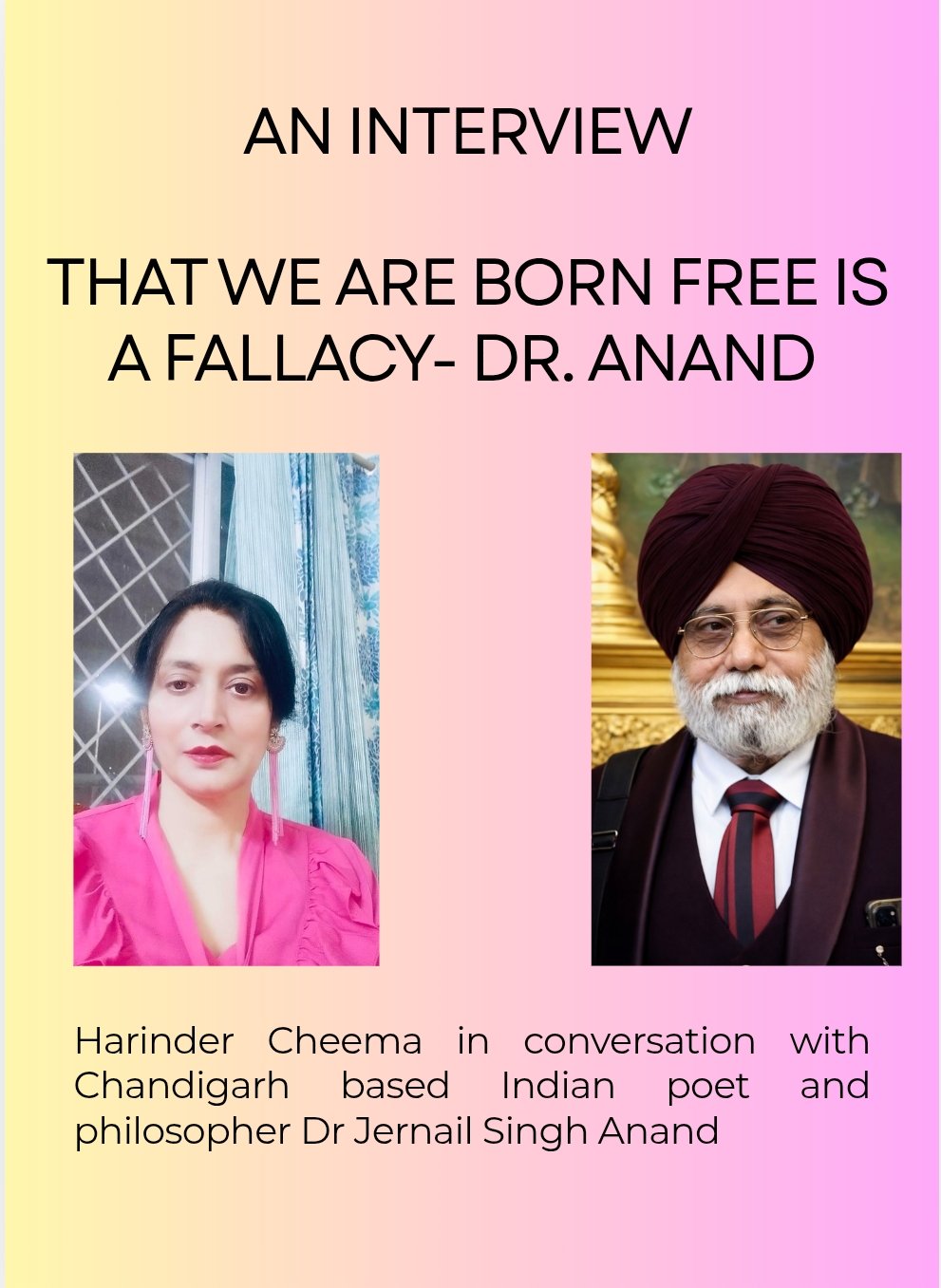
Harinder Cheema in conversation with Chandigarh based poet and philosopher, Dr. Jernail Singh Anand who has authored more than 200 books out of which 20 are epics.
[Harinder Cheema is an internationally acclaimed, award-winning poet, novelist, author, editor, anchor, and motivational speaker. A distinguished Naji Naaman Laureate, she is recognized among prominent global literary voices and has been featured in 50 Memorable Women, Asia by the Stockholm Project. Her work has also been showcased by the prestigious Farsala Academy in Greece and Café Philo , New Delhi.
Her poetry has been translated into numerous national and international languages, reflecting its wide resonance across cultures. As a motivational speaker, she has been invited by several colleges and universities across India, where she inspires audiences with her literary insight and thought leadership. She has also graced various national and international literary festivals as a distinguished guest.
With a rich body of work and a profound literary presence, she is a proud recipient of numerous awards, accolades, and recognitions in the field of literature].
- What does "Karma" mean to you and how does one get liberated from the Karmic chains?
‘Karma’ means our actions. But it also includes the concept of ‘dharma’. ‘Dharma’ stands for our duty to act in a particular situation. Now, if we act as per our conscience, this falls in the category of action. And if we do not perform our duty, this too falls in the category of action. Personally, I believe that action is only a physical representation of our thoughts. I look upon our thoughts also as a sort of pre-action state. In other words, our intentions are as potent as our actions. Just imagine, if we are having good intentions towards somebody, the entire eco-system around us is surcharged with goodwill, and it leads to a happy environment all around. Just a feeling on our part creates this sense of wellness. But, if our intentions are bad, even if we do not act, the atmosphere around us gets vitiated, which affects our eco-system and all those closely associated. Thus, I think that when we act, and even when we do not act, we are taking part in ‘karma’, and our feelings play an active role in deciding the course of action.
I think according to the theory of ‘Karma’ man is responsible for his actions. Lord Krishna says: we can act upon our will, but we have no control over the fall out of our actions. This is absolutely true. I also feel that actions once undertaken, fall into the realm of public discourse, and get out of our control. Moreover, I have articulated the idea of Associated Responsibility in my epic, ‘Revelations’, according to which, no action is isolated, and, while evaluating a criminal, all those who directly or indirectly helped him in the crime, should also be arraigned.
2 Why do humans fear death while knowing it is the only certainty?
Since the time of our birth, and all through life, we are living with the idea of life, its problems, its joys. Life keeps us so busy that we have no idea that this life is a temporary bestowal, and we are trapped in time, which is slipping like sand from our fingers and one day, the gas cylinder will be exhausted, and we might have to send it for a refill. The idea of death scares us because we have often seen what happens to people who die, how their bodies are given over to flames, or just placed in graves dug deep. It is a horrible sight whiting us and, naturally, we dread this destiny.
Your question is : why we are afraid of it when we know it is a certainty. It is a certainty no doubt, but angels have been kind to us. The time of death is not disclosed to anybody. I have seen some thrillers, in which, a warning is written on the first page, not to open the last page, or you will lose the suspense. In the same way, if we know when and where and how of our last moments, our life will be filled, not with joy but horror. And living thereafter will be a difficult experience.
In my opinion, life and death are so mixed up, that the moments that we live, actually die, and from these dying moments, we weave our past. Death is a constant companion, and takes its pick every day. We should not be afraid of it. Yet, who wants extinction? Nothing can console human soul, not even if I say that life and death are two states of water, like steam and ice. Will it console a worried soul? I wonder.
- Suffering is an inevitable part of our existence ! Do you see it as a punishment or as a teacher shaping us with a rod?
Suffering falls within the ambit of the ‘Karmic’ theory. Most of the time, we are at the receiving end, and very few are the moments, when we are allowed to exercise free will. How much free will a person has, who has grown up on the palm of another person? This analogy fits us well, because earth is the palm on which we grow, and after some time, turn waste. If we apply the theory of Karma, all the suffering is the result of our previous actions, of which we are absolutely unaware, because our memory is obliterated before angels pack us afresh. We apparently do not remember our past. It is a mystery zealously guarded by angels, and nobody, no oracle can tell us what we were in the past.
So far as your question is concerned, I believe that just as we cannot eat anything which we have not cooked, or, we eat whatever we cook, in the same way, whatever is served to us in our lives, is something that we have cooked ourselves, that we have merited. If it is suffering, then, it has a logic behind it, which is, however, unknown to us. If we take suffering like a punishment, then, we are expected to face the punishment with grace, so that at the end of it, we are exonerated. [Salvation [Moksha]]. But that is not human nature to accept suffering as divine punishment. Our minds are equipped with a component called Knowledge, which gives us a little understanding of the phenomenon. Although every day we use this proverb: ‘A little knowledge is a dangerous thing’, yet we never realise the knowledge at our command is shallow, and it cannot answer the questions of life and death. In this way, we add misery to our suffering, and lose dignity as well as human grace. We must draw a line between suffering which is god given, and misery which is self-inflicted.
- How do you see "Truth"? Is it absolute or does it change with experience and perception?
Truth is absolute, and remains unchanged. That God created man, in his own image, and God wants him to carry out his brief, this is eternal truth. Nature is an objective truth. Vegetation, winds, waters, mountains – every object is part of the eternal truth. Man is also a part of it. Our humanity is also truth which we have confronted from time to time. What changes is its complexion. Or, you can say, it is present in its various versions. While the truth that is represented in nature is unitary and unique, the truth that permeates the human world suffers from various weaknesses, because, men are smart, and they possess knowledge, with which they can alter the very nature of things. In fact, the evolution of human mind is often found in conflict with the eternal truth. Moreover, worldly truth is perceptional, and therefore, variable. For different people, the truth of a situation differs, and they act the way it appeals to them. Just imagine, when a case is presented in a court of law, the advocates can play smart with truth of an event. How you tell a story, what you tell before, and what comes after, - this narrative arrangement affects the truth of an event. In this way, it is safe to say that apart from the eternal truth ingrained in elements, the worldly truth is a variable agency, to which people react as per their convenience.
- Are we born free or born in chains? How do you explain the paradox of "Free Will" vs " No Choice"?
That we are born free is a fallacy. Yes, the chains which run around us, are not physical not visible. These chains belong to the limitations of our ‘Karma’ which determines our destiny. Let me first bust the myth of ‘free will’. Can we place our own order with our father and mother? Do they know whom they will conceive? Can we decide the colour of our skin? Can we decide our own facial features? We cannot decide when we shall hit this earth, and when we shall be kicked out. This is the extent of our free will. Then, how much can you grow? A seed has ingrained strength to grow up to a point. We cannot outsmart natural processes. The most important and disheartening thing is that the world is full of wealth and resources. Yet, people who are born in poor families, have no access to the wealth of the world. Only dacoits and in the past, and smugglers in modern world amass wealth, which, at the end, we see, scattered around and turned waste.
What is it all going to establish? That man is not a free agent. He is suffering from invisible constraints. Just as our mobile chip is connected to a tower which gives it life, so are we connected to a higher agency, which monitors our actions. So far choices are concerned, the idea of choice is very limited. If you want to eat ‘bariani’ or ‘sweet meat’, you can apply your freedom of choice. But for how long? Here your choice fails. Ultimately, in my opinion, man is a highly limited entity, and when he does not realise his limitations, he grapples with the unknown and causes friction in the universe. All the disharmony that we find in world society, is the result of people who fail to bring their sense of selfhood in conformance and harmony with cosmic forces.
DR JERNAIL S ANAND
Dr. Jernail S. Anand, with 200 books to his credit [20 epics] is a Chandigarh-based polymath, and a vital architect of the 21st century ethical literature whose seminal work ‘Lustus: The Prince of Darkness’ challenges the moral complacency of our era. Founding President of the International Academy of Ethics, and Laureate of Charter of Morava [Serbia], Seneca [Italy], Franz Kafka [Germany, Ukraine, Czech Rep] and Maxim Gorky [Russia], his name is inscribed on the Poets’ Rock in Serbia. He is an Honorary Member of the Serbian Writers Association, Belgrade. Anand has built a poetics that unites ethics, Vedic spirituality, social critique, and the philosophy of meaning. Anand presents an articulated perspective on poetry as an instrument of planetary consciousness. A moral philosopher, professor, and international speaker, Anand has devoted much of his research to the ethical dimension of language, to the responsibility of the individual within a globalised society, and to the relationship between matter, consciousness, and transcendence. Email: anandjs55@yahoo.com.
Bibliography:
https://sites.google.com/view/bibliography-dr-jernal-singh/home
https://share.google/QtiWrcFr7Sca7v0qC




 English
 Afrikaans
 Arabic
 Bengali
 Bulgarian
 Chinese (Simplified)
 Dutch
Dutch Filipino
 Finnish
 French
 German
 Greek
Greek Hausa
Hausa Hindi
Hindi Hungarian
 Igbo
Igbo Italian
 Japanese
 Korean
 Malay
Malay Malayalam
 Polish
 Portuguese
 Punjabi
 Romanian
 Russian
 Serbian
 Slovak
 Spanish
 Swahili
 Ukrainian
 Urdu
Urdu Yoruba