
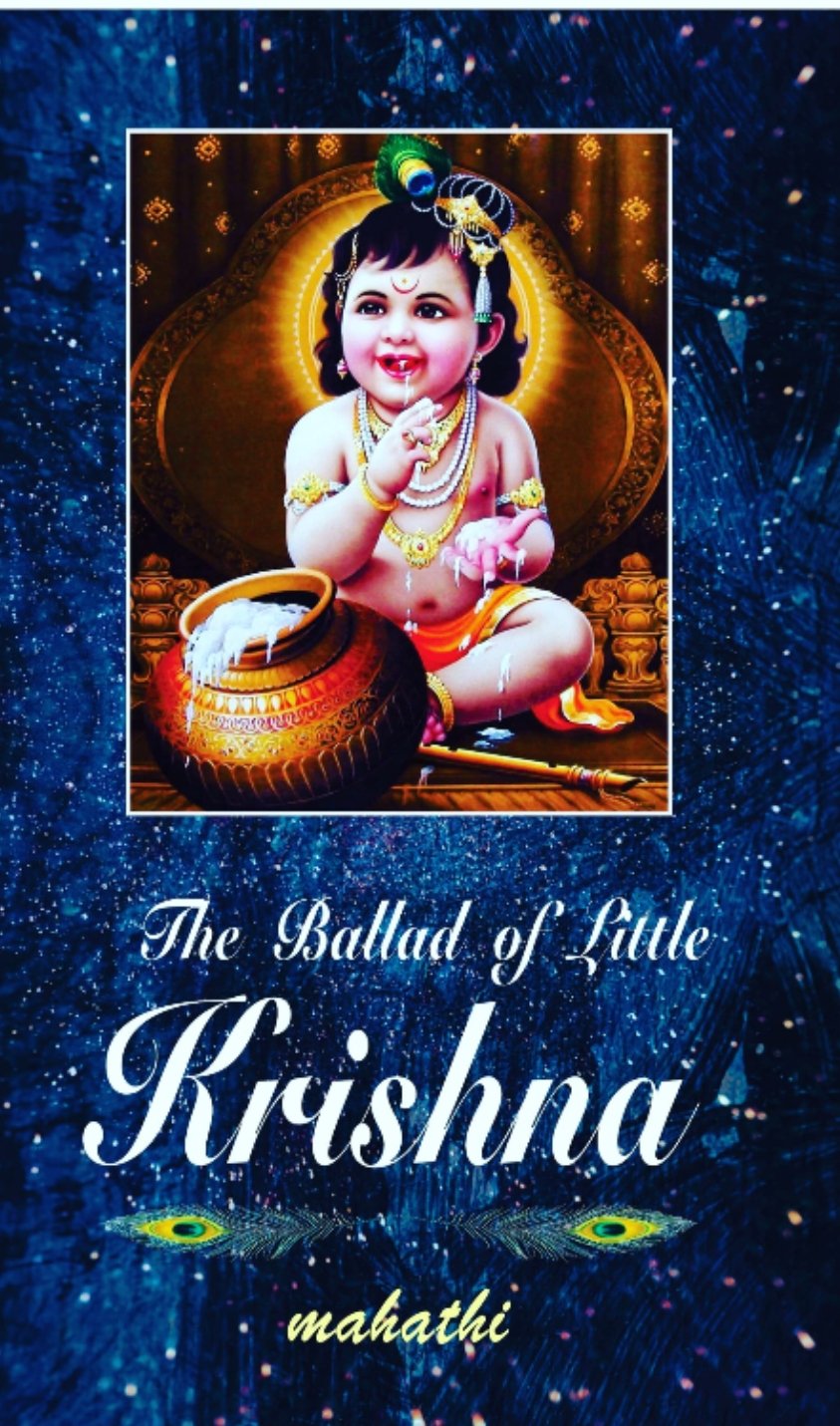

Mydavolu Venkata Sesha Sathyanarayana, who writes with the penname ‘Mahathi’, in his work ‘The Ballad of Little Krishna’ establishes new benchmarks in devotional poetry. While basking in transcendental glory, the poem also addresses aesthetic concerns of modern readers. Mahathi is a celebrated writer from Nellore, Andhra Pradesh, who has authored around a dozen books, including several translations, which have created a literary ferment. From a lawyer with leftist leanings, Mahathi turned to literature, and then, took a turn towards spiritual poetry. A master of metrical verse, his major works ‘The Ballad of Little Krishna’, ‘Mother Ganga’, ‘Ocean Blues’ and ‘The Roar at Twilight – Sonnets of Lord Narasimha’ are considered all time classics. A devotee of Brahmarshi Sri Narada Parabrahma, his first biggest attempt was re-creating Sri Sundara Kanda, the fifth Canto of Srimad Ramayanam, with the title ‘Finding the Mother’.
It is both a joy and a privilege to introduce ‘The Ballad of Little Krishna’ a work that takes the timeless story of Lord Sri Krishna Vaasudeva and renders it anew — “in lyrical and narrative ballads… in simple English, keeping in mind the modern reader’s interest and propensities,” while never diluting the depth of its spiritual inquiry. The story of Lord Krishna is told with great love and devotion. What distinguishes this song eternal is its form actually parallels an epic with its grand scale, elevated language and the sublime story told in equally elevated style.
From its very first invocation, the book announces its purpose. The epigraph sets the cosmic frame: “—O scion of the Bharata dynasty, whenever there is a decline in Dharma and increase of adharma, then do I manifest Myself.” That promise of the Srimad Bhagavath Gita is the heartbeat of this narrative. Mahathi explains why the Lord descends: “When demonic forces thus take a dominance over the earth, the result is chaos, dwindling of virtues and upraise of sins. That is when the God descends donning an Avatar to save the earth from increasing weight of sins (paapa bharam).” The tale that follows — of Kamsa possessed by the demonic spirit Kalanemi, of Devaki’s imprisoned womb, and of the Lord’s own arrival — presents the myth not as mere entertainment, but as a source of sensiblizing human response to cosmic phenomenon.
In an age when ancient epics often reach us only from the devotees, told in the language of love, ‘The Ballad of Little Krishna’ by Mahathi restores the story of Sri Krishna Vaasudeva with both classical cadence and post-modern clarity. Written in lyrical and narrative ballads, the work invites the contemporary reader into the eternal drama of dharma’s restoration without sacrificing spiritual depth or poetic beauty.
The book opens with the timeless assurance of the Gita:
यदायदाहि धर्मस्य ग्लानिर्भवति भारत।
अभ्युत्थान मधर्मस्य तदात्मानंसुजाम्यहम्॥ १४.७
When a Yadava king named Kamsa is possessed by the demonic spirit Kalanemi, it disturbs the cosmic balance. Devaki and Vasudeva are imprisoned and their six infant sons are slain. The seventh pregnancy ends in a mysterious miscarriage. Then, as the eighth child, “Lord Narayana Himself descends as Lord Sri Krishna Vaasudeva.” The entire narrative that follows unfolds the restoration of dharma.
The book also brings into discussion debative issues in the Hindu epics like Rasa Leela, curses and boons given by saints/sages, etc .
The prayer that precedes the narrative captures the devotee’s pure impulse:
I scrawl ‘Hare Krishna, Krishna’;
my quill as Ram impels!
When sure can quell all sin; my ink,
why other tales I tell?
Dedicated to Lord Sri Krishna Vaasudeva, the work begins in the ominous silence of Kamsa’s prison. Two dumb torches glow in vain while a mother’s painful wail rises. The tyrant strides forward to slay the new-born, yet light fills the cell, the oily dirt becomes divine perfume, and a sky-blue form with golden streaks appears. The Lord speaks: “O Mother Devaki, in womb thine holy; lies my soul! … It’s not in here I further live, but in Vrajapuram, the greenly green village of plain cowherds of love wholesome!”
This is the apocalyptic moment when chains snap, prison doors open of their own accord, guards lie as if dead, and Vasudeva carries the radiant child through storm and flood. Yamuna gives way, the thousand-hooded serpent shelters them, and the exchange of infants is accomplished under the veil of Maya. Later, when Kamsa seizes the girl-child, she rises into the sky as the fierce form of the Goddess, declaring: “What use trying to kill me fool, what use killing the kids? Your slayer is born, living elsewhere.”
The distinctive voice of the book is a narrative that is at once dramatic, philosophical and musical. The ballad moves with devotion, pausing at times to reflect on human condition, caught between divine and demonic impulses, as we witness Kamsa swinging between momentary remorse and renewed malice, illustrating the author’s observation that a being born with demonic strain remains “half devil, human half”.
“This fight between the bad and good
in every eon goes on.
Good’s good for them; bad’s good for us.
Two sides on earth so born!”
The poem achieves a fine balance between the classical sources and the modern impulse. Throughout the forty-seven cantos that follow—from Poothana and the demonic cart to the lifting of Govardhana, the rasa leela, and the final confrontation in Mathura—the same dual relationship is maintained: loyalty to the classical sources and loyalty to the modern seeker’s need for clarity and relevance. It makes the work highly readable as a pure story, as a spiritual meditation, or a poetic celebration of Lord’s ‘leelas’.
Mahathi is master of epic poetry. Here we witness his writing charged with celestial magic:
With great amazement sipped
that blessed couple,
the nectarous spill of sacred light,
missing nothing of that great spectacle!
Yashodha’s revelation of Little Krishna and the unfolding of the divine spectacle is breath taking:
She kept gazing, gazing,
without a wink;
her eyes letting warm tears of joy,
body shuddering with rapturous sweating.
“Oh who am I and who this boy with dazzling halos?
Is this a dream?
How whole cosmos
In that small mouth did grow?”
At Vridavanam, the day time engagements are described which, in a way, give a respect to manual labur, which keeps men close to the divinity:
“We rear the cattle boys;
sell milk, till lands and grow food grains for all;
our livelihood it’s;
so pious, so chaste, divine!”
What makes this retelling distinct is its form and its voice. The author consciously chooses the ballad, a mode of song and memory, to carry Krishna’s ‘leelas’. “The story runs in lyrical and narrative ballads. Though the format is old and style is classical, the way it’s told is very modern,” and that modernity lies in clarity, not dilution. The text does not shy away from philosophy; it “discusses in deep, various spiritual conundrums at length, and tries to explain many issues in the Hindu epics often subjected to doubt and criticism like Rasa Leela, curses and boons given by saints/sages.” So the reader is invited to sing, to question, and to understand.
May this ballad kindle in every reader the same quiet joy that filled the jail cell on that rainy Ashtami night, when chains fell away and the path to Vrajapuram opened under the shelter of the divine serpent. In the author’s own closing cadence of the opening movement, we experience divine magic:
Hare Rama, Hare Rama,
Rama, Rama, Hare, Hare,
Hare Krishna, Hare Krishna,
Krishna, Krishna, Hare, Hare.
To sum up, Mahathi’s work transcends time and space, and tries to give a modern orientation to a story which has been told and retold for centuries. It will be remembered for its lyrical rendering, its divine message, as well as for its aesthetic charms. While I congratulate the poet, and welcome the work to the immortal store of mythical lore, I commend “The Ballad of Little Krishna” to all who seek both beauty and truth in the eternal story of the Lord.
Reviewed by:
Dr. Jernail S. Anand,
President, International Academy of Ethics.
Laureate of Charter of Morava, Seneca, Franz Kafka and
Maxim Gorky Award, and Honorary Member of the
Serbiab Writers Association, Belgrade.

12 Oct. 2026. Chandigarh.
Email: anandjs55@yahoo.com



 English
 Afrikaans
 Arabic
 Bengali
 Bulgarian
 Chinese (Simplified)
 Dutch
Dutch Filipino
 Finnish
 French
 German
 Greek
Greek Hausa
Hausa Hindi
Hindi Hungarian
 Igbo
Igbo Italian
 Japanese
 Korean
 Malay
Malay Malayalam
 Polish
 Portuguese
 Punjabi
 Romanian
 Russian
 Serbian
 Slovak
 Spanish
 Swahili
 Ukrainian
 Urdu
Urdu Yoruba