
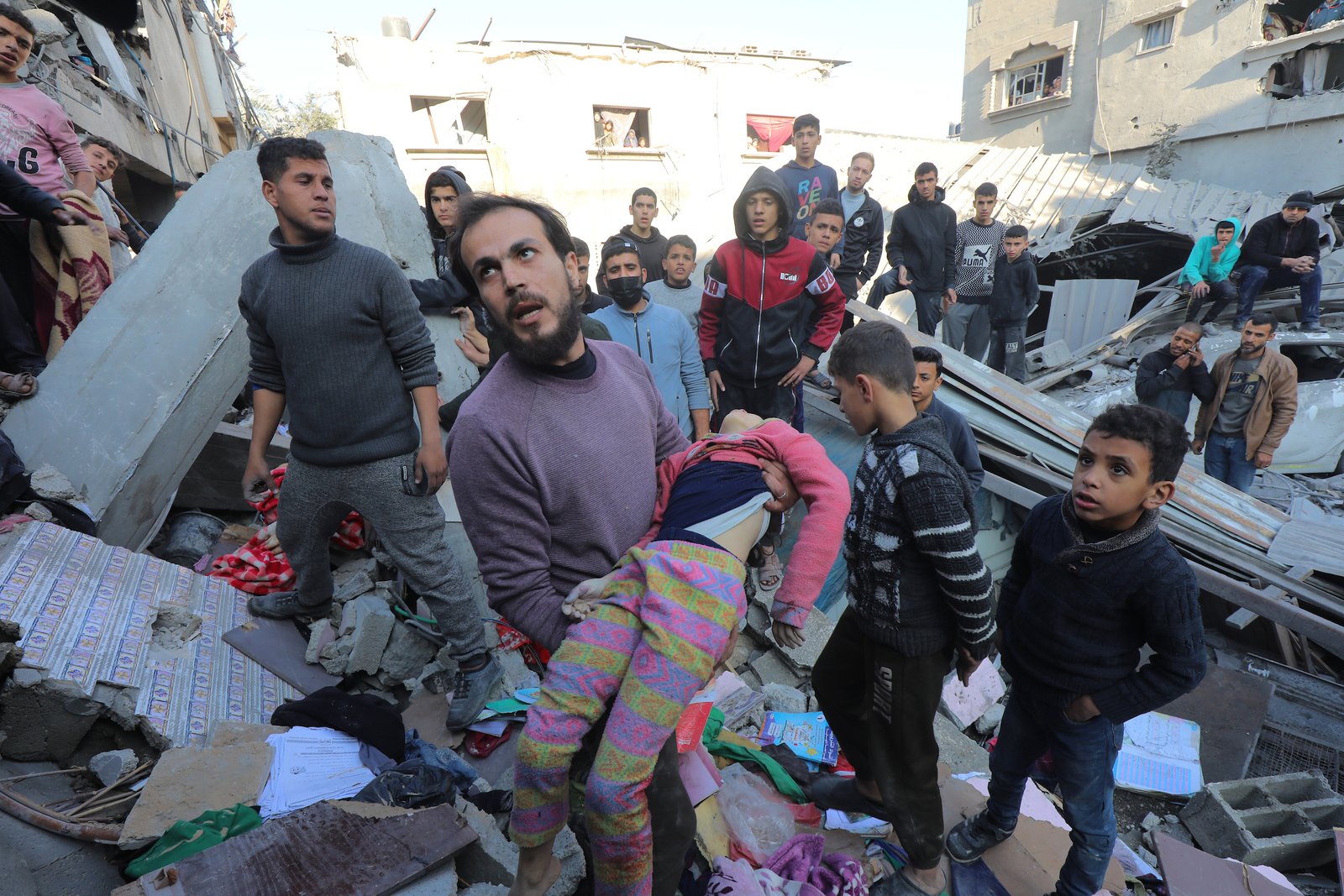
Professor Mustafa Bahgat Badawi says in his book "talk about us and about Israel”: As I always say, Israel is not only a threat to the entity of Palestine, but it represents a real danger even to the smallest house in the most remote village of this entire Arab homeland. And The conclusive evidence is what happened in Beirut, in Sidon, and what could happen in any other location or village in any part of the entire Arab homeland with an Israeli" infiltration adventure". Hence, the Arab countries should give the gift of one man, settle their differences and prepare –rightly and diligently - to confront their bitter enemy. The Stone play written by Dr. Ahmed Asaker revolves around the legitimate Palestinian resistance against the Israeli entity that usurps our lands, and any Palestinian resistance is an important and necessary thing for Arabs as a single nation suffering from an existential threat due to this cancer that has been planted on its land. In the first and second chapters, Dr. Ahmed Asker, in an intelligent interview that is not devoid of psychological connotations, presents the vision of each party in this continuous and eternal conflict, the Israeli entity puts forward its future plans through a discussion among its members, and we know from it how to use America as a cudgel to crush us, and the implementation of all its plans, which has already happened.

Marzel: the most powerful country in the world right now is America, followed by Britain, and the Arab countries around us, the most powerful of which are Egypt, Iran, Syria and Iraq. – What?!
Marzel: we will sow discord between America and one of these countries that I mentioned, and we will make the American president, who is a strong ally of ours, and a precious catch, head towards one of them, let it be the state of Iraq, this is the one I want now.( Pp. 18: p. 33) The writer went on to reveal their evil plans, which are currently being implemented on the ground towards Egypt and the entire Arab nation, we read:
Marzel: Egypt was strangled from the south, we strangled it with Sudan and water, and here we are strangling Sudan and strangling it from the south from which we are kidnapping it. We surrounded his West and separated him from it. Then we have treaties that we will not break now. Egypt is not now. It is Syria and then Iran that I want, and also I don't care from the first and from the second, and if it were up to me, I would take the two countries together. They are from the countries of the axis of evil that we have created, and let's call them state sponsors of terrorism (P.27).
While the resistance leaders are mired in disagreements and talk about the past that is useless behind it, standing on the ruins is a pure Arab heritage, we Arabs pay a lot of attention to the past, and we rarely look at the future, and I do not say we plan for it. And this is what the writer wanted to clarify in the second chapter: Platoon leader: for fifty years, sir, they have been spreading murder and slaughter among us as if it were their eternal chant. Have they not yet seen, Sir, from the rivers that flow and the seas that run for the blood of our men and our leaders all these years-all this praise - I mean sacrifice? -! Abu Al-Qasim: they want to take us out of here.They are stealing our ancestral past, destroying it, they want to uproot us, and as our resistance movement intensifies and grows stronger, we call for their peace (pp. 36: p.49). Abu Al-Qasim (the second scene of the second chapter): we are peace. Our religion is peace.No, boss. They are the advocates of war, the opponents of peace. Their hands are still stained with the blood of innocent people in the cities and camps of Deir Yassin, Sabra, Shatila, Qana and others. Sheikh Mujahid Al-Qaid Ahmed Yassin appears in the third scene of the second chapter to put his hand on the reasons for the division between the leaders of the battalions and the leaders of the Palestinian factions, which also applies to the countries of this great Arab homeland, we read some of what he said : Sheikh: don't you see, leaders and leaders, that we have divided into many peoples and many teams. Abu Mustafa: yes, Sheikh. God has many divisions and many people. Shaykh: and don't you see, leaders and leaders. That our enemy is all one! Voices: yes..Yeah The sheikh: so why is this band? -! Why the band Why the band is often and always why, leaders! Voices: it's always the band, Sheikh. Sheikh: rather, it is a search for personal glory, for false heroism to support our cause. Not to establish our state and to support our people or peoples( pp. 56, 57). The Palestinian people were and still are in need of a real leadership that would be vigilant and the magnitude of the danger it faces, and when such leaders emerged, they would mobilize the national feeling behind them quickly and effectively, as happened in the case of Sheikh Izz al-Din al-Qassam, who was only a legitimate authority in Haifa but believes in the importance of an organized revolution to prevent the establishment of a Jewish national homeland in Palestine. The Palestinians must rely on themselves first in their struggle against Zionism. Sheikh al-Qassam started his revolution with just ten of his men, each with only a rifle and a small amount of money.. They decided to direct their revolt first against the mandate Authority, which was arming the Jews.Then al-Qassam was martyred with his men in an unequal battle against the British authorities on November 20, 1935. But this martyrdom inflamed national feelings in Palestine to a huge degree.. The masses refused to march ten kilometers to mourn the body of the martyrs, which was a natural prelude to the comprehensive Palestinian revolution in 1936. Returning to Sheikh Al-Qaid's refutation of the significance of this conflict, we read: Sheikh: they want us in a permanent conflict, in a conflict with our enemy, in a conflict with each other, with ourselves. May the bleeding of the land, wealth, agriculture and our blood remain, May the bodies of our martyrs remain. May our blood and oil continue to provide the West with prosperity and progress, well-being and wealth In the third chapter, the writer limps back to the history of the Jenin Camp massacre, opening his conversation with the question of who made a profit on Jenin If we have touched the difference between their thinking and ours, and Sheikh Al-Qaid put his hand on the causes of division in the second chapter, then through this chapter he refers to another disease that has afflicted the nation, the disease of betrayal - which he was one of its victims-until one of the soldiers in the fifth chapter shouts: the number of traitors, Sir, exceeded the number of the enemy..They are many, and another says: their danger is greater than the danger of the enemy(P .138). Shaykh: we are monitored, father Al-Qasim.. The enemy is monitoring our movements. He sees us and knows the steps of our guys, and I think that's the accuracy with which our leaders hunt. That skill he shows in assassinating them, only an internal betrayal of elements belonging to us..Their Apaches could do nothing in heaven if only one on Earth was guiding them and illuminating their black vision(P.83). If the massacre of the Jenin camp shows the ugly face of the Zionists; those who were killed unarmed and buried in mass graves, it also shows that this ugliness befell everyone who prevented weapons from reaching the people of the camp. And whoever this damned woman supplied Israel with all these modern weapons. In an intense bitter dose, the fourth chapter witnesses the martyrdom of Sheikh Al-Qaed, the daughter of Jenin, and the daughter of the Resistance leader Abu Al-Qasim, so the writer paints us a very dark painting that sheds tears, and her chest boils, yes. There is no state that has been wrapped up by a night like the night of Palestine, like the death of Palestine .. Funeral after funeral, martyr after martyr. And if the first chapter recognized the consistent pattern of resistance thinking by using stone as a weapon of resistance with which they intimidate the enemy of Allah and their enemy, and resorting to qualitative and individual operations, Abu Al-Qasim Our resistance is no longer limited to a man blowing himself up in a car, a tank, or a few soldiers for them (P.162). The writer promises us that the advice of the martyr Sheikh Al-Qaid has come to fruition, and that the legitimate Palestinian resistance has changed its way of thinking, it will not wait for the enemy's attack on its land, but will transfer the battle on its land and inside its settlements. From the first moments of birth, Israel has embraced the offensive doctrine in the war, allowing it to always keep in its hands the military initiative, which provides it from the very beginning many advantages against any Arab party it faces. Since the first truce that was reached with Israel, it has always been the one that initiated the violation of the truce against the Arab side, at a time when the Arab side believed that the international character of the agreement would deter Israel from breaking it! Thus, in light of this sudden violation of the truce, Israel increased the area of the lands it captured, so that at that time it became 77% of the territory of Palestine, while the partition decision guaranteed it only 55%. Israeli Defense Minister Moshe Sharett said that I would prefer that we attack the Arabs and the world condemns US. It’s about waiting for the attack and the world supports us. .. We read: Abu Al-Qasim: I promise you that after cleansing our house, ourselves and our people from traitors and agents. They never came back to hack us again... This is my first and most important task in my next stage and I will not fight... And I'm not going to wake up to an infection until I'm done with it. I will destroy their houses as they destroy ours and I will scatter them as they have scattered US... I will change our tactics, plans and war with them... Those whose hearts are different and we count them as one... I'll make them different... I'm gonna hit them in their backyard.. I'm going to throw our missiles at them and our catapults... The one who will cut their backs... And the Katyusha that will melt their skins (P. 158). The third scene of the last chapter explains a commando operation known as the snake's head, in which Abu Al-Qasim was targeted by a group of Zionist soldiers and their commander, an operation that Israeli newspapers described as the day of panic, the day of sorrow. Abu Al-Qasim returned from it, wounded, martyred and joined the processions of martyrs, dreaming and we are with him: I want to see this today. The one where one of our cubs is raised...The flag of Palestine fluttered high on every hillock... And he raises it at every foot of our slopes. I want to see this boy who comes by day and takes away from us this night (p. 173).




 English
 Afrikaans
 Arabic
 Bengali
 Bulgarian
 Chinese (Simplified)
 Dutch
Dutch Filipino
 Finnish
 French
 German
 Greek
Greek Hausa
Hausa Hindi
Hindi Hungarian
 Igbo
Igbo Italian
 Japanese
 Korean
 Malay
Malay Malayalam
 Polish
 Portuguese
 Punjabi
 Romanian
 Russian
 Serbian
 Slovak
 Spanish
 Swahili
 Ukrainian
 Urdu
Urdu Yoruba