
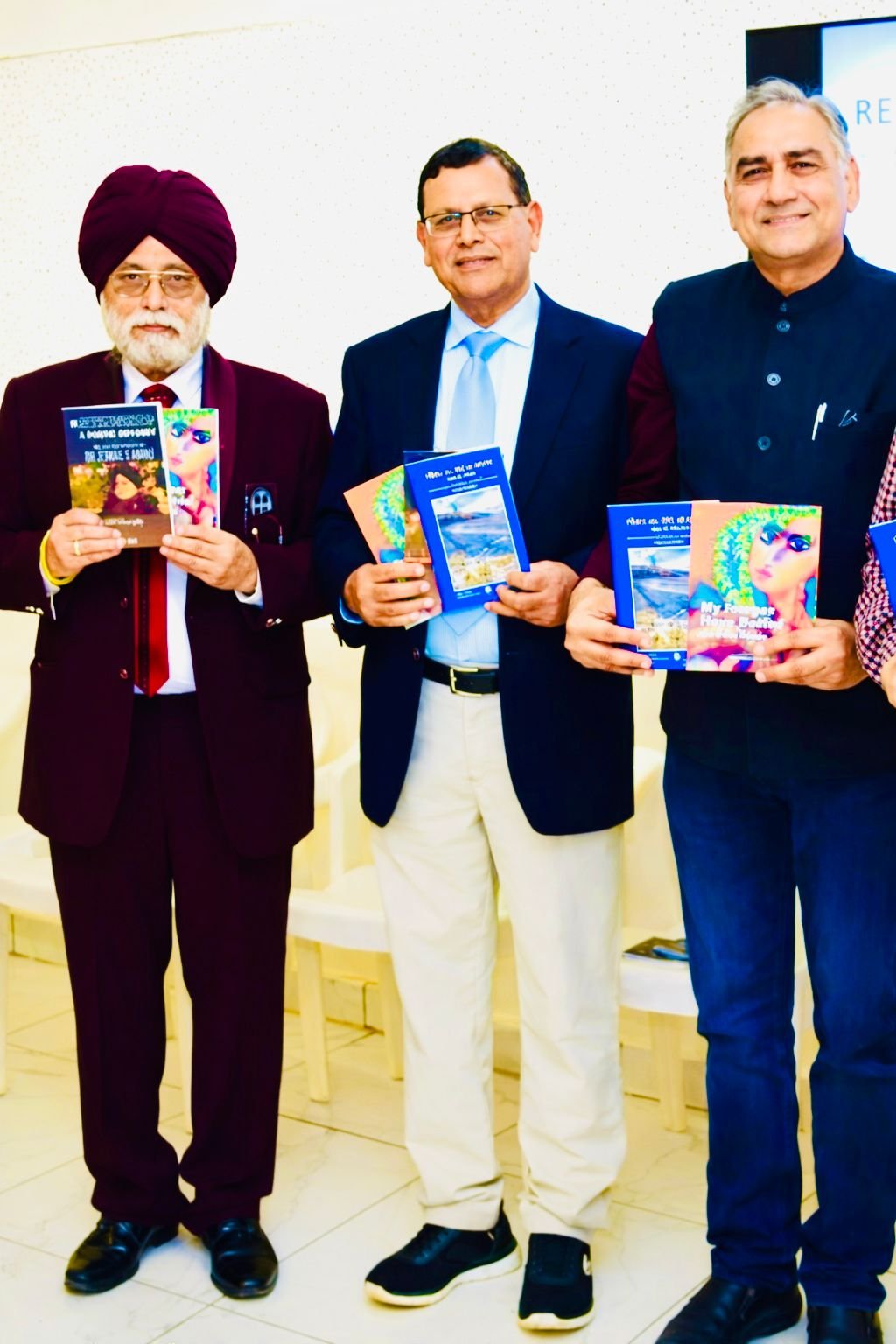
For Ashok Bhargava's book titled ‘Journeys Within and Beyond’, consisting of 34 beautiful poems in English with Hindi translation on Ladakh, perhaps I was the most appropriate reviewer because I have visited Ladakh three times. Ladakh is such a magical place that you can't visit it only once. It was just a chance that the PDF of this book landed on my computer screen. Whatever feelings the writer expressed were exactly the ones I experienced when I first visited Leh and Kargil in 2015. I ruminated about writing poetry on the Supernatural beauty of Ladakh. It was sheer procrastination on my part that ‘aaj likhta hun, kal likhunga “ karte karte time guzrta gaya, and I could not write. As a student, I had read Swet Marden’s book “Avsar Ko Pehchano”, and it says that catch hold of the time from its front hair when it approaches you, because time is bald from behind and you can't catch it after it has crossed your path. It is especially true in the case of writing poetry. I missed it. But I think God is great (or Dr Anand is great) who has served me with the poems I wanted to write myself. Let me tell you, Ladakh is a Union Territory with Leh and Kargil as its two district headquarters.

Ladakh’s uniqueness strikes you as soon as the plane touches the runway. You are met with warm sun and a sense of dizziness from altitude sickness. In the very first poem, the poet is stunned by the beauty of the land and its people, comparing them to a hidden smile of nature. The altitude of the place makes one feel that one has come very near to the abode of God..

In the poem “City of Leh” the poet expresses a deep emotional connection to Leh upon arrival. The open sky and boundless, barren earth surrounded by high hills bring a sense of calm and freedom from the humdrum life of the plains. The longing for such a landscape is fulfilled, erasing the accumulated past fatigue like magic. One is easily lost in a sense of timelessness due to a heavenly silence all around. You can only hear the sound of the wind blowing past your ears.
The poet talks of the centuries-old Leh Palace, which is visible from most of Leh town, as it is situated at the highest point in the city.
In another poem titled ‘Encounter’, the poet feels a surge of youthfulness within him when he says--
‘... In grey hair and wrinkles, A new life stirred again. For a moment, breaths turned to music, the winds struck a sweet melody, Feet began to move to an unknown rhythm, as if some old dream had come true…’
The poet describes Ladakh as a land filled with love and spiritual connections. Nature and culture intertwine, creating a tapestry of love across the region. The poet is so enamoured of the place that he writes’…I want to lose myself in you forever- It reminds me of the song from movie ‘Kismet’- Aao Huzur tumko sitaron me le chalun…’
We all know that our country was named India because of the Indus River, which quietly flows beneath the city of Leh and keeps you company when you travel from Leh towards Kargil, flowing along the roadside. The Indus River is portrayed here as a vital source of life and spirituality. The poet expresses a deep connection to the river, viewing it as a mother figure. The journey along the river symbolises a quest for self-discovery. The road to Kargil has very little traffic and occasionally you may be lucky to see a golden yellow mountain fox trying to hide in the hills.
Monasteries and Spiritual Reflections
The poet visits various monasteries dotting the area and reflects on their spiritual significance. Each monastery offers a unique experience of peace and meditation. The silence and stillness of these places allow for deep introspection. Multi-coloured Prayer flags at the entrance of centuries old monastries flutter in the cold mountain wind giving a sense of timelessness. In the sanctum sanctorum of every monastery, the statue of Buddha, sits in eternal peace. The poet writes-
‘...In Buddha’s eyes, no words abide, only endless lakes of compassion
And further’… Where time comes to rest, And the soul at last comes to find itself…’
In his poem ’Alchi monastery’, he describes this 1000-year-old monastery, where the original murals still survive. The style of the murals and miniatures at Alchi is superior to those at Tabo monastery in Himachal and Tholing in Tibet. The colours used were derived from stones and minerals, which is why they still glow even after 1000 years. People believe that these paintings were not done by humans but by Gods, and that too in one night. The monasteries were constructed without steel, cement, or glass, only with mud, stone, and little wood, and have stood as spiritual sentinels for centuries. Each monastery offers a unique experience of peace and meditation. Ashok does not forget to write a poem about the Gurudwara Pathar Sahib, which reminds us of Baba Nanak's visit to Ladakh. Local people call him ‘Nanak Lama’. A demon hurled a huge stone down the hill to kill him, but it turned into wax upon touching the body of Babaji. You can still see the imprint of Guru Nanak’s body on the stone. The Indian Army is responsible for maintaining the Gurdwara.
He also talks in his book about major must-visit places like Khardung-la, Magnetic Hill, Pangong Lake, many villages, and Siachen Glacier. The Lamayuru monastery he talks of is situated in a place that looks like the moon’s surface.
The in-depth analysis of each place and poem may not be possible here in such a short time.
The return journey evokes feelings of nostalgia and reflection.
He vistfully writes- ‘…The time slips through my fingers, Like Kargil’s cold wind in the fading light Or grains of sand tumbling down a dune…’The poet vows to remember the beauty and peace of Ladakh and to wish his poems to endure beyond his lifetime.
Yes, I can identify with Ashok Bhargava’s feelings. Ladakh is a unique place, for where else will you find such purity in the air, spirituality in the ambience, silence all around, stupas and monasteries with their prayer wheels and fluttering flags and buntings, surrounded by barren, brown hills. Hardly anyone can forget the apricot trees laden with pink flowers in Kargil, giving a feeling of being in heaven, as if God was somewhere nearby.
I personally have a great respect for these poems and shall remember this book for many, many years, despite having read and reviewed scores of other poetry books.
Thank You all.

Ashok K Bhargava is a multi faceted personality, a poet, reviewer and a literary heavyweight from Canada who is heading the International Writers Network.
'Vinod Khanna is President of Readers and Writers Society of India. chandigarh, a poet and a reviewer and editor of international journal ' Salahiyat'




 English
 Afrikaans
 Arabic
 Bengali
 Bulgarian
 Chinese (Simplified)
 Dutch
Dutch Filipino
 Finnish
 French
 German
 Greek
Greek Hausa
Hausa Hindi
Hindi Hungarian
 Igbo
Igbo Italian
 Japanese
 Korean
 Malay
Malay Malayalam
 Polish
 Portuguese
 Punjabi
 Romanian
 Russian
 Serbian
 Slovak
 Spanish
 Swahili
 Ukrainian
 Urdu
Urdu Yoruba